Image
Category
Collection
Maker
On Display
Object type
Place
Material
Date
Buckskin amulet in the form of a turtle

Buckskin amulet in the form of a turtle

1850-1930

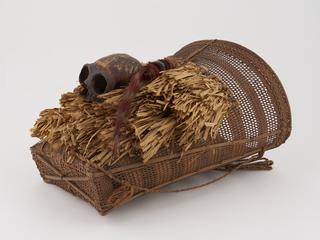
Head hunter's basket decorated with raffia fringing

Head hunter's basket decorated with raffia fringing

1851-1920

Preserved human left hand, mid 19th century

Wax injected human left hand

1831-1870

Pathology specimen of a lung Secondary carcinoma of the stomach in the lung. Human remains preserved in Kaiserling III solution, mounted in an acrylic container.

Pathology specimen of a lung

Sectioned skull, by Tramond, French, 1870-1900

Prepared anatomical skull

1870-1900

Pathology specimen of a brain Brain: Haemorrhagic infarction. Humain remains preserved in Kaiserling III solution, mounted in an acrylic container.

Pathology specimen of a brain

Pathology specimen of a heart Aortic valve endocarditis. Human remains preserved in Kaiserling III solution, mounted in an acrylic container.

Pathology specimen of a heart

Preserved human left arm

Wax injected human left arm

1831-1870

Pathology specimen of an appendix Gangrenous appendicitis. Human remains preserved in Kaiserling III solution, mounted in an acrylic container.

Pathology speciemn of an appendix

Pathology specimen of a kidney Kidney: Hyoid cysts. Human remains preserved in Kaiserling III solution, mounted in an acrylic container.

Pathology specimen of a kidney

Lung specimen, whole slice of right lung with carcinoma. This specimen is from a female patient aged 60, a regular smoker with a short history of coughing.

Lung specimen

before 2010

Pathology specimen of a tongue Diphtheria: tonsillar and trachael. Human remains preserved in Kaiserling III solution, mounted in an acrylic container.

Pathology specimen of a tongue

Pathology specimen of a arteries Blood vessels showing medial calcification (Monkeberg's Sclerosis). Human remains preserved in Kaiserling III solution, mounted in an acrylic container.

Pathology specimen of arteries

Pathology specimen of a liver Fatty liver in pernicious anaemia. Human remains preserved in Kaiserling III solution, mounted in an acrylic container.

Pathology specimen of a liver

Pathology specimen of a lung Secondary carcinoma of the stomach in the lung. Human remains preserved in Kaiserling III solution, mounted in an acrylic container.

Pathology specimen of a lung

Anteroposterior axis sectioned scapula bone, and proximal end of a humerus bone, exhibiting signs of osteoporosis

Sectioned scapula bone and end of humerous bone

before 2010

Pathology specimen of an ear scar Squamous carcinoma of the ear. Human remains preserved in Kaiserling III solution, mounted in an acrylic container.

Pathology specimen of an ear scar

Pathology specimen of a lung Lung: Acute interstitial emphysema and bronchopneumonia. Human remains preserved in Kaiserling III solution, mounted in an acrylic container.

Pathology specimen of a lung

Cranium from skull, showing effects of leprosy, from a medieval Danish leprosy cemetery, now in St. Jorgen's churchyard, reputedly c.1350, discovered 1930-1967

Mature female cranium (skull)

1250-1500

Mandible (jaw bone) showing effects of leprosy, from a medieval Danish leprosy cemetery, now in St. Jorgen's churchyard, reputedly c.1350, discovered 1930-1967

Mature female mandible (jaw bone)

1250-1500

Pathology specimen of a cervix Carcinoma of the cervix. Human remains preserved in Kaiserling III solution, mounted in an acrylic container.

Pathology specimen of a cervix

Left and right foot showing effects of leprosy, from a skeleton from a medieval Danish leprosy cemetery, reputedly c.1350

Left and right foot showing effects of leprosy

1250-1500

One male human skeleton of Iron Age date from Whitegate Farm, Bleadon. 'Bleadon Man’ is a skeleton of a 50 year-old man found during the building of new houses in Bleadon, Somerset, near Weston-super-Mare, in 1997. He had been 5 feet 6 inches (1.68 metres) tall and suffered from arthritis. The bones were carbon-dated to 100 BCE

Skeleton of Bleadon Man, 1999.

100 BCE

Mummified infant, no provenance, Egyptian, 2000-101BCE (see note).

Mummified infant, Egypt, 2000-101 BCE

2000-101 BCE

Mummified head, without wrappings, no provenance, Egyptian, 1300-300 BCE

Mummified head, Egypt, 1300-300 BCE

1300-300 BCE

Microscopical preparations of section of tubercular lung, glass, prepared by Dr. James Macartney, Dublin, 1824

Microscopical preparation of a tubercular lung, Dublin, Ireland, 1824

1824

Sectioned skull in glass display case, by Tramond, French, 1870-1900

Prepared anatomical skull in glass display case

1870-1900

A set of 12 slides, large format (5" x 7" or 6" x 8") with thin-sectioned human tissue, each stained with one of the three stains (haematoxylin and eosin, modified silver or thionin-based Nissl stain).

Set of 12 human tissue slides

circa 2009

Leather amulet with bead decoration, possibly turtle or lizard form, likely to contain umbilical cord, Indian Plains, North America, late 19th century

Beaded amulet in form of a turtle

1871-1900

Buddhist human skull vessel and brass stand, Tibetan, 18th or 19th century

Buddhist human skull vessel and brass stand

1701-1900

Microscopical preparation of tumour, prepared by Dr. Thomas Hodgkin, glass plate, 1833-1837

Microscopical preparation of a tumour, England, 1833-1837

1833-1837

Model head with long hair on metal bar

Model head with long hair on metal bar

Box of slides named 'Misc i', containing human remains, part of the Frank Horrocks collection of microscopical preparations.

The Frank Horrocks collection of microscopical preparations

Microscope slide, dated March 1866, of TRICHINA in human muscle prepared at the London Hospital.

Microscope slide of TRICHINA in human muscle

1866-03

Vomer (small thin bone from the nose), in 3 fragments. From skeleton showing effects of leprosy, from a medieval Danish leprosy cemetery, now in St. Jorgen's churchyard, reputedly c.1350, discovered 1930-1967

Mature female vomer (nose bone)

1250-1500

Microscopical preparation of injected foetal half-stomach, glass plate, possibly prepared by John Quekett (1815-1861), 1838-1842

Microscopical preparation prepared by Quekett

1838-1842

Plastic bag containing used pair of hand gloves and singular finger glove, finger glove containing traces of blood. From Doctor's bag that previously belonged to Dr. Tertius Watson.

Plastic bag containing used pair of hand gloves and singular finger glove

Bowl, made from top of human skull, three copper wire feet, Tibet, date uncertain

Bowl, made from top of human skull

Small glass bottle with black lid, containing a brownish orange gel-like sbstance adhered to side of bottle, likely a medium used to carry out bacteriological tests. 'Mr Latey 92nd [spit] transf from 21/8/44 --/6/44 608/BL or 131' written on bottle with some illegible text.

Small glass bottle with black lid

1945

Small glass bottle with white lid, containing a brownish orange gel-like substance adhered to one side of glass, likely a medium used to carry out bacteriological tests with signs of past culturing growth. Illegible text [spit] and '4.1.44' written on bottle.

Small glass bottle with white lid

1945

Small glass bottle with a black lid, 2 thirds full of straw coloured liqud containing a light brown floating substance, likely a medium used to carry out bacteriological tests. 'Adkins direct from spit ... cold ... 4.I.44' written on bottle with illegible text.

Small glass bottle with a black lid

1945

Small glass bottle with cream lid, dark browny orange gel-like substance, likely a medium used to carry out bacteriological tests. Contains a thick globule, likely a sample of skin as noted on the bottle. 'ray [skin] 31.3.44' written on bottle.

Small glass bottle with cream lid

1943

Small glass bottle with a cream lid, orange-brown, gel-like, substance with crust and bumps adhered to side of bottle, likely a medium used to carry out bacteriological tests. 'Mr Latey scalp 12.6.44' written on bottle.

Small glass bottle with a cream lid

1944

Small glass bottle with a cream lid, containing an orange gel-like sub adhered to side of bottle, likely a medium used to carry out bacteriological tests. Containing small piece of human skin. 'R[a]y [skin] .3.40' written on bottle.

Small glass bottle with a cream lid

1944

Three bacteriological samples of human lung on paper, 2 in mounts. Stored in box with flowers and coloured square pattern, with gold edges. Labelled 'Horrocks slides 34'.

Microscope slide containing a horizontal section of a Human retina

1 slide containing human remains, removed from set of glass microbiological slides in a box with flowers and black and white pattern,with gold edges. Labelled 'Horrocks slides 36'. Reads: 'cells, squamous epithelium (cheek) smear H&E, Morley 1958'.

The Frank Horrocks collection of microscopical preparations

1958

Skull with mandible and vomer, showing effects of leprosy, from a medieval Danish leprosy cemetery, now in St. Jorgen's churchyard, reputedly c.1350, discovered 1930-1967

Mature female skull with mandible

1250-1500

Kurdaitcha sandal/shoe, made of matted emu feathers, blood, hair cord and knitted string, part of kurdaitcha hunting ritual, Arrernte people (Arunta), central Australia, 1880-1920

Kurdaitcha sandal/shoe

1880-1920