Match book, safety matches, five layers glued to cardboard cover, Pyroca patented, French, 1900-1930 Match book 1900-1930
5 paper matches, phosphorus tipped, rolled paper stem flattened and held together by the phosphorus head, in envelope, European, 1800-1900 5 paper matches 1800-1900
Plain envelope, rectangular containing 6 lucifer matches, pine splint ends covered in sulphur, tipped with phosphorus, English, 1828-1850 Plain envelope 1828-1850
Envelope containing strip of fusee matches, amadou fungus oblong strip divided into ten individual matches but joined at the base, phosphorus blobs at tip, made in Berlin, East Germany, 1832-1860 Envelope containing strip of fusee matches 1832-1860
Match, tubular length of fibre, white fibre core, green outer fibre, calibrated along its length by blobs of phosphorus, European, 1800-1880 Match, tubular length of fibre 1800-1880
Collection of 18 "strike anywhere" matches, long narrow splints of chipboard with sulphur and phosphorus tips, 2 broken Collection of 18 "strike anywhere" matches
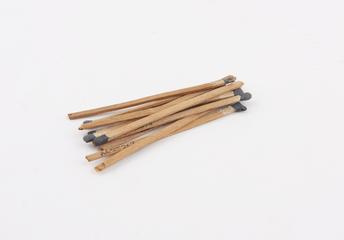
3 wooden congreve matches, square in section, tipped with sulphur and phosphorus 3 wooden congreve matches
3 strips of later fusees, nitre soaked cardboard with phosphorus blobs on the ends, English, 1840-1889, later type of fusee since the phosphorus has not been applied by equilateral dipping of the strip but by the application of a single blob of phosphorus covering nothing like the entire surface at the end of the match, a feature of the older fusees 3 strips of later fusees 1840-1880
Seven fusees, in two strips, one of four matches, one of three, flat cardboard divided strips, nitre soaked phosphorus tipped, by Hynam, English, 1832-1880 Seven fusees 1832-1880