Image
Category
Collection
Maker
On Display
Object type
Place
Material
Date
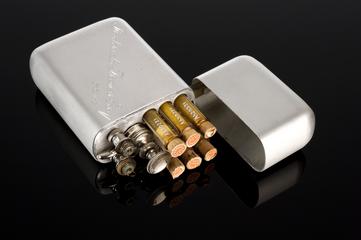
Hypodermic syringe with glass phials of drugs

Hypodermic syringe with glass phials of drugs

1885-1910

Hypodermic injection kit in metal case in leather draw-string pouch with 5 tubes of hypodermic tablets (strychnine sulphate, atropine sulpahte, mercuric chloride, digitalin and aconite nitrate) and 2 needles. Made by Burroughs Wellcome, English, c. 1926.

Hypodermic injection kit with tubes of drugs

1926

Amber glass bottle with plastic lid full if 100 Aloin, Belladonna, Strychnine and Cascara Sagrada tablets. English, mid-twentieth century

Glass bottle containing Aloin, Belladonna, Strychnine and Cascara Sagrada tablets

Black simulated leather effect case with metal clasp, containing 12 labelled glass phials of tablets. 12 bottles contents as follows: 'Penacetin' (phenacetin and caffine - half full of tablets); 'Tab ha Phenobarbital' (phenobarbitone - around 14 tablets remaining); 'Digitalin & Nitroglycerin comp. (cardiac)' (strychnine, digitalin, nitroglycerin - half full of tablets); 'Pulv Ipecac CO. B.P. Dover Powder' (opium, ipecac - 3 tablets remaining); 'Palatinoids Hydrarg Subchlor' (mercury chloride - full of tablets); 'aperiens, fort' (Aloin, Jalapin, mercury chloride, gingerin - half full of tablets); 'laxoin' (dihydroxyphthalophenon - 3/4 full of tablets); 'hypnogen' (phenobarbitone - 4 tablets remaining); 'ergota praeparata' (Alaloids of ergot, ergotoxin - half full of tablets); 'butyl chlor gelsemin quinine' (butyl chloral hydrate, gelsemin, quinine - half full of tablets); 'Acetosal' (acetysalicylic acid - half full of tablets); 'Nitroglycerium' (nitroglycerine - full of tablets). Case: height 38 mm x width 243 mm x depth 91 mm, weight 310.90g; phial: height 85 mm x diameter 19 mm. Case inscribed: 'OPPENHEIMER SON & Co, LTD'. Manufactured by Oppenheimer Son and Co. Ltd., case inscribed 'Dr. E. Pringle'. English, 1870-1930.

Black simulated leather effect case containing 12 labelled glass phials of tablets.

1910-1940

Amber glass bottle with bakelite lid full of strychnine powder. English, twentieth century

Glass bottle containing strychnine powder

Amber glass bottle with glass stopper half-full of Aromatic Bismuth and Pepsine liquid (MIST. BISMUTH AROM. c. PEPSINO). 224 mm x 77 mm diameter, 725 g. Used as an anti-dyspeptic, ingredients include bismith, pepsine, chloroform, morphine, and nux vomica (strychnine). Gale, Baiss and Co., London, 1930-1970.

Bottle of Aromatic Bismuth and Pepsin

1930-1970

Engraved pocket syringe kit inside cotton draw-string pouch, containing a syringe and 7 glass phials of hypodermic tablets (morphine and atropine, morphine sulphate, atropine, cocaine, strychnine). Parke Davis & Co., English, c. 1930.

Engraved pocket syringe kit inside cotton draw-string pouch

1930

A bottle of 'Syrup of Poppies' with trace residues remaining, unsigned, England, 1870

Bottle of 'Syrup of Poppies' with trace residues remaining

1870

Case for hypodermic syringe, syringe missing, containing a variety of hypodermic tablets in glass phials, as well as one needle. 149 mm x 96 mm x 23 mm, 202g. The phials are of varying sizes and manufacturers, and they are composed of atropine, strophanthin, adrenalin, novacain, apomorphine, and styrchnine. The case also contains one small phial of atropine opthalmic tablets. Parke, Davis and Co. and Burroughs Wellcome, English, mid-twentieth century.

Hypodermic syringe case with accessories

1920-1950

Glass bottle with glass stopper, recent label obscured painted label. Half-full of liquid nux vomica (strychnine). (see note)

Bottle containing liquid nux vomica

Glass jar with plastic lid half-full of strychnine hydrochloride powder. English, twentieth century

Glass jar containing strychnine hydrochloride powder

Veterinary medicine chest, oak, with main storage compartment in three sections and a drawer, formerly the property of the Hawkins family, Staunton Court, nr. Gloucester, with various contents of the medicine chest including instruments, glassware, ointment jars, paper packets of medicine, and other medical preparations. The top drawer of the chest contains glass medicine bottles, mostly with glass stoppers. Some of the bottles are empty, although some still contain medical preparations. Other substances present in the glassware include antimony, digitalis, tobacco, ipecacuanha powder, ammonium hydrochloride, strychnine (in a green glass poison bottle), and calomel (mercury chloride). The removable bottom shelf contains metal ointment pots, and various medicines in paper packets, including aresnic. Unknown maker, English, c. 1870.

Veterinary medicine chest

circa 1860

Hypodermic syringe case (needles and syringe missing), with 8 glass phials of medicinal preparations. Case: 85 mm x 55 mm x 18 mm. The 5 larger glass phials ( 50 mm x 5 mm diameter) contain hypodermic tablets by Burroughs Wellcome and Co., of caffeine sodio-salicylate, strychnine, ergotinine and strychnine, apomorphine and pilocarpine nitrate. The three smaller glass phials (26 mm x 3 mm diameter) contain opthalmic tablets by Parke Davis and Co., of atropine, homatropine hydrobromide and physoatigmine. English, 1930-1950

Hypodermic syringe case with 8 glass phials of medicinal preparations

1930-1950

Hypodermic syringe kit, complete with syringe, needles, and four hypodermic tablet phials, by Arnold and Sons, London, England, 1905 pattern but for use during the First World War, 1914-1918.. One phial contains digitalin tablets, one phial contains strychnine hydrochloride, and one contains morphine tartrate.

Hypodermic syringe kit

1914-1918

Phial containing morphine tartrate, from hypodermic syringe kit, by Arnold and Sons, London, England, 1905

Phial containing morphine tartrate

1914-1918

Glass phial with cork stopper full of chocolate-coated 'Neuralgic' tablets (zinc phosphate, strychnine, cannabis extract). 58 mm x 11 mm diameter, 5 g. Parke, Davis, and Co., London, 1880-1930.

Phial of 'Neuralgic' tablets

1880-1930

Tin syringe kit with flip top containing a syringe, hypodermic needle, and six glass tubes of hypodermic tablets with cork stoppers. Overall: 80 mm x 45 mm x 20 mm, 71g. Glass tubes include: apomorphine hydrochloride, strychnine nitrate, morphine sulphate, atropine sulphate, cocaine hydrochloride, and a morphine and atropine compound, all in the form of hypodermic tablets. Parke, Davis and Co., London, c. 1940s.

Tin syringe kit with flip top containing a syringe

1935-1950

Glass bottle originally for Tabloid 'Soda Mint' containing 5 small phials of hypodermic tablets (cocaine hydrochloride, hyoscine hydrobromide, morphine sulphate, strychnine sulphate and digitalin). 80 mm x 20 mm diameter, 13 g. By Burroughs Wellcome and Co., English, 1900-1919.

Bottle for 'Soda Mint' containing phials of hypodermic tablets

1900-1910

Hypodermic syringe kit, complete with case, syringe, needle, and four hypodermic tablet phials, one containing digitalin; one containing strychnine hydrochloride; and two containing morphine tartrate, by Arnold and Sons, London, England, 1905 but for use during the First World War, 1914-1918.

Hypodermic syringe kit, with syringe and four phials: digitalin; strychnine hydrochloride; and two containing morphine tartrate

1914-1918

Metal syringe case with instructional leaflet, syringe wires, hypodermic needle and 10 glass tubes with cork stoppers of hypodermic tablets. 20 mm x 85 mm x 75 mm, 154g. Tube contents are: Morphine and atropine sulphate (compound), atropine sulphate, strychnine nitrate, trinitrin, cocaine, morphine sulphate, and apromorphine. Burroughs Wellcome, London, 1940s.

Metal syringe case with instructional leaflet

1935-1950