Image
Category
Collection
Maker
On Display
Object type
Place
Material
Date
Florence Cook

Florence Cook

1865-1875

Metal memento mori finger ring, set with 1 large square transparent stone, with hair, surrounded by 4 small clear stones and ornate band bearing champleve inscription, 1747

Memento mori finger ring

1747

Gold brooch, in the form of a 'Youth Contemplating Death' cameo, 1700-1799

Gold brooch, in the form of a 'Youth Contemplating Death' cameo, 1700-1799

1701-1800

Gold memento mori finger ring, with transparent setting containing human hair, possibly 18th century

Memento mori finger ring, with setting containing human hair

1701-1800

Brooch containing locks of hair, gold thread and pearls, arranged against a pearly background, marked in an oval frame, covered with a glass

Brooch containing locks of hair

Metal memento mori finger ring, set with a large square transparent stone which contains a skull on a hair background with a red and gold border, engraved inscription inside band, 1709

Memento mori finger ring, with a stone containing a skull on a hair background

1709

Wrist or ankle cord of twisted hair of female members of family against evil spirits, sickness and misfortune, Indian, 1870-1930

Wrist or ankle cord against evil spirits, sickness and misfortune

1870-1930

Metal ring, circular, with a transparent square stone which contains hair, champleve enamelled inscription on band, 1722

Metal ring containing hair

1722

Lock of hair said to be from George III, 1760-1820, wrapped in a piece of paper inscribed 'Hair of His late Majesty King George the Third Received from Sir K. Taylor 27 January 1927'

A lock of hair, reputedly from King George III

1760-1820

A lock of hair, said to be from the head of Edward IV of England (1442-1483), taken from his tomb at Windsor in 1784, mounted in a frame, and secured by wax to a piece of paper bearing a handwritten descriptive inscription

Lock of King Edward IV's hair

before 1784

Lock of Napoleon's hair, cut off by Dr. Barry O'Meara at St. Helena. Napoleon Bonaparte (1769-1821) was exiled on St Helena from 1815 until his death in 1821

Lock of Napoleon's hair

1815-1821

Belt, consisting of ring of coiled string made of human hair, mounted on cardboard, from Australia, 1880-1920

Belt made from human hair, Australia, 1880-1920

1880-1920

Black belt made from roll of twisted strands of human hair with pair of decorated shell ornaments attached, used by Australian Aboriginal people, 1881-1920

Black belt made from roll of twisted strands of human hair, Australian Aboriginal, 1881-1920

1881-1920

String of plaited hair, part of amulet which originally included shell plaque, from North West Australia, 1890-1920

Amulet made from hair, Aboriginal North West Australia, 1890-1920

1890-1920

Lock of Napoleon's hair, cut off at St. Helena. Napoleon Bonaparte (1769-1821) was exiled on St Helena from 1815 until his death in 1821

Lock of Napoleon's hair

1815-1821

Catherine Cooper's red hair, 2000.

Catherine Cooper's red hair

2000

Pair of ceremonial shoes, made of compacted feathers gum and blood, with uppers of woven human hair, used by kurdaitcha, Arrernte people, North West Australia, 1890-1920

Pair of ceremonial shoes

1890-1920

Gold memento mori finger ring, with rectangular swivel setting containing hair, under glass, with inscription on back of bezel, 1815, in memory of John Coakley Lettsom

Gold memento mori finger ring

1815

Carved wooden doll highly stylized female figure, long column shaped body, hair is real, carried on the back of a girl to show she is ready for marriage, Bissagos Islands, Guinea-Bissau, Africa, 1880-1925

Carved wooden doll, Bissagos Islands, Guinea-Bissau, Africa, c. 1880-1925.

1880-1925

Pair of ceremonial shoes made of compacted feathers, human hair and blood, used by Kurdaitcha, Australia, 1890-1920

Pair of ceremonial shoes made of compacted feathers

1890-1920

Glass and silver slide, oval, with initials E.H. overlaid on cloth or plaited hair, with skeleton and hourglass, c. 1700-1800

Memento mori, c. 1700-1800

1701-1800

Native imitation shrunken head of gourd and human hair, Ecuadorian, 1850-1935

Imitation shrunken head

1850-1930

Gold and crystal slide, a memento mori of a skeleton supported by 2 cherubs, with initials J.S. and inscribed "Come ye Blessed"

Memento mori, Europe, 1601-1700

1601-1700

Hand pad made from emu feathers matted together with blood and enclosed in hair string, part of kurdaitcha ritual, used in conjunction with kurdaitcha shoes, Arrernte people, Northern Australia, 1880-1920

Hand pad made from emu feathers matted together with blood and enclosed in hair string

1880-1920

Necklace made of human hair and shells, from Australia, 1870-1920

Necklace made of human hair and shells, Australia, 1870-1920

1870-1920

Lock of Duke of Wellington's hair and 2 invitations to his funeral

Lock of Duke of Wellington's hair

1800-1852

Small oval brooch with lock of hair inside, personal relic of William Mansell, likely English, 1800-1850

Small oval brooch with lock of hair inside

1800-1850

String of beetle elytra, with tuft of human hair at distal end, for decorating shrunken head, South American

Shrunken head decoration of beetle elytra and hair

before 1919

Brooch, containing flowers and a monogram made up from hair, arranged against a white background, mounted in an oval meal frame and covered with glass, fastener missing

Brooch, containing flowers and a monogram made up from hair

Girdle or "acachu" made from human hair, from Tutanangosa, South America

Girdle or "acachu" made from human hair

before 1930

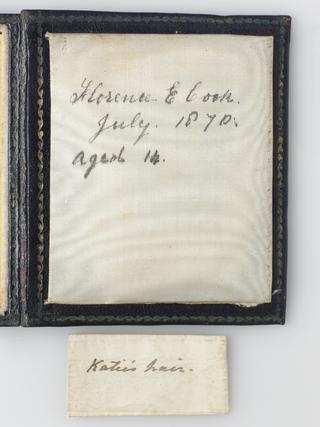
Ambrotype portrait of Florence Cook, in a leather case, unsigned, England, 1865-1875. Florence Cook was a medium associated with William Crookes.

Florence Cook

1865-1875

Photograph, possibly of a painting of Florence Nightingale, and a lock of her hair, framed, c1854-1870

Florence Nightingale photograph and lock of hair, 1854-1870

1854-1870

Piece of pearl shell, leaf shaped with human hair cord attached with gum, used to press back gums during tooth-avulsion operation, from Sunday Island, Victoria, Australia, 1881-1920

Piece of pearl shell

1881-1920

Bull roarer, made of wood with loop of human hair, decorated with painted blue pattern, slightly worn eaten, from Katherine River district, Australia, 1871-1925

Bull roarer

1871-1925

Ceremonial left shoe made of compacted feathers, blood, fibre and hair cord, used by kurdaitcha, made by Arrernte people (Arunta), central Australia, 1890-1920

Ceremonial left shoe made of compacted feathers

1890-1920

Mourning ornament consisting of human hair wrapped in clay and fat and covered with red ochre, amuletic, from North West Australia, 1880-1920

Mourning ornament consisting of human hair wrapped in clay and fat and covered with red ochre

1880-1920

Ceremonial hand pad made of feathers compacted with blood secured by hair-string, used by kurdaitcha, Arrernte people, Australian, 1890-1920, for tourists (?)

Ceremonial hand pad made of feathers compacted with blood secured by hair-string

1890-1920

Gold finger ring, circular, with large oval setting with pearls set around perimeter, an urn madeof hair and bearing the initials I.W. in centre

Ring

Black pubic-cover of strands of human hair, associated with circumcision ceremonies of Arrernte people (Arunta), Central Australia, 1881-1920

Black pubic-cover of strands of human hair

1881-1920

Brooch, containing locks of hair, gold thread and pearls, arranged against a pearly background, mounted in an oval metal frame and covered with glass, fastener missing

Brooch, containing locks of hair

Headhunter's basket made of cane and decorated with white seeds, coloured beads and fringe of coloured human hair, probably work of Naga people, Assam, Indian, 1851-1920

Headhunter's basket made of cane and decorated with white seeds

1851-1920

Gold pendant, or memento mori with entwined hair and inscription, seal attached, 1852

Gold pendant

1852

Piece of memento mori, possibly from a slide, consisting of oval piece of glass backed by plaited hair and a picture of a skull

Piece of memento mori

before 1937

Lock of hair removed from Edward Jenner after his death, 26th January 1823, framed (passe-patrout)

Sample of Edward Jenner's hair, England, 1823

1823

Four copper anklets, hair bound with metal wire, worn only by married women of the Toro, Himu, Iru, Ciga and Hutu, Ancole, Ugandan, 1880-1920

Four copper anklets

1880-1920

Pair of pointing bones, attached by twisted band of hair, used by Kurdaitcha of Kaitish tribe, Central Australia, 1870-1920

Pair of pointing bones, Central Australia, c. 1870-1920.

1870-1920

Gold brooch, a memento mori to John Amery, with painting of mother and children next to an urn made of hair and studded with seed plants, 19th century

Memento Mori Brooch

1801-1900

Brooch containing locks of hair, gold thread including a monogram, arranged on a blue background, mounted in an oval metal frame and covered with glass, fastener missing

Brooch containing locks of hair

Carved wooden pointing stick, double-barbed, with hair string attached by gum, covered with red pigment, from Central Australia, 1881-1925

Carved wooden pointing stick

1881-1925

Bundle of plaited human hair, Peruvian, 800-1400

Bundle of plaited human hair, Peruvian, 800-1400

800-1400