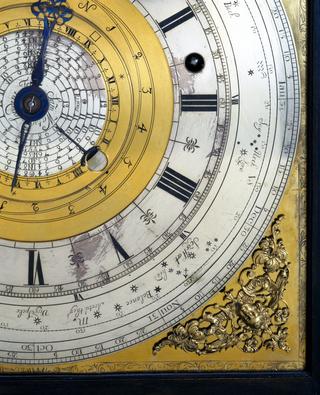
Pedestal astronomical clock by Samuel Watson, London, England, in ebonised case, with one cranked winding key and two door keys, 1690-1710. Time Measurement gallery label: ASTRONOMICAL CLOCK A pedestal clock, signed Samuel Watson, London, and made about 1695. It is the earliest English astronomical clock in which the sun is fixed, on the Copernican principle, and it shows, besides the time of day, the date, the position of the sun in the Zodiac, the phase of the moon and its latitude (important for eclipse predicitons), and the times of sunrise and of moonrise and moonset; the time of high tide at London Bridge can also be read off. Samuel Watson was born in Coventry about 1635 and worked there until about 1690, when he moved to London. He died about 1710. A much more elaborate astronomical clock was made by Watson over the period 1683 to 1690, to the order of King Charles II; this clock is now in the Royal Library at Windsor Castle. Pedestal astronomical clock by Samuel Watson 1690-1710
Bracket clock by Ellicott, London, with two winding keys and two door keys Bracket clock by Ellicott 1760-1769
400-day 'anniversary' clock, brass base with circular glass shade, disc pendulum with 6-pillared gallery, 2 winding keys, numbered 68382, possibly by Jahresuhrenfabrik, Germany, 1898-1915. 400-day 'anniversary' clock, brass base with glass shade 1898-1915
Copy of a Dwerrihouse skeleton clock with coup-perdu escapement. Made by Thwaites and Reed, London, England, 1973. No. 88 of a limited edition of 100. Copy of a Dwerrihouse skeleton clock with coup-perdu escapement 1973
Bracket clock by Ellicott, London, with three winding keys, one door key, and one winding handle Bracket clock by Ellicott, London, with two windin