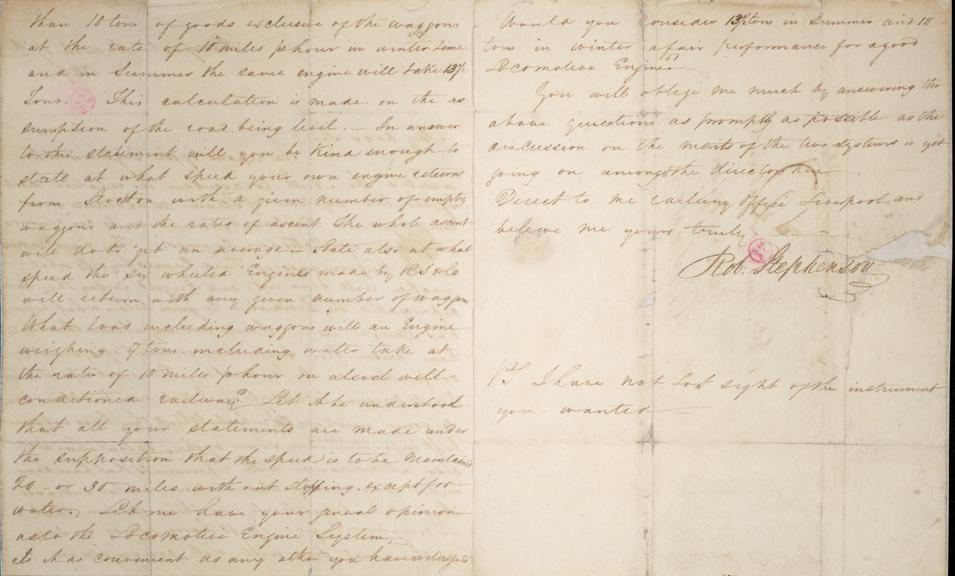
Letter from Robert Stephenson, Liverpool to Timothy Hackworth, Darlington, Railway Office


 This image is released under a CC BY-NC-SA 4.0
Licence
This image is released under a CC BY-NC-SA 4.0
Licence
License this image for commercial use at Science and Society Picture Library
LicenseThis image is released under a CC BY-NC-SA 4.0
Licence
License this image for commercial use at Science and Society Picture Library
License
Science Museum Group Collection
© The Board of Trustees of the Science Museum
Science Museum Group Collection
© The Board of Trustees of the Science Museum
'Engineers who visited the North to ascertain the relative merits of the two systems of Steam machinery now employed on Railways', fixed engines vs. locomotives. Referenced in Robert Young, Timothy Hackworth and the Locomotive (London: Locomotive Publishing Company, 1923),p. 175.
Details
- Extent:
- 1 item
- Identifier:
- HACK/1/1/21
- Transcription:
-
Show
Liverpool March 17th
1829
My dear Sir
The reports of the Engineers who visited the North to ascertain the relative merits of the two systems of Steam machinery now employed on Railways, have come to conclusions in favour of Stationary Engines. They have increased the performance of Fixed Engines beyond what practice will bear out, and I regret to say they have depreciated the Locomotive Engines below what experience has taught us. I will not say whether these results have arisen from prejudice or want of information or practice on the subject. This is not a point which I will presume to discuss. I write now to obtain answers to some questions, on which I think they have not given full information. Some of their calculations are also at variance with experiments that have come under your daily observation. For instance they state it positively as their opinion that a Locomotive Engine of 10 horse power or say of the usual size will not convey more than 10 tons of goods exclusive of the wagons at the rate of 10 miles p hour in winter time and in Summer the same engine will take 13 ½ Tons. This calculation is made on the assumption of the road being level. In answer to this statement will you be kind enough to state at what speed your own engine returns from Stockton with a given number of empty wagons and the rates of ascent. The whole ascent will do to get an average. State also at what speed the six wheeled Engine made by R S & Co. will return with any given number of wagons. What load including wagons will an Engine weighing 9 tons including water take at the rate of 10 miles p hour on a level well conditioned railway? Let it be understood that all your statements are made under the supposition that the speed is to be maintained 20 or 30 miles without stopping, except for water. Let me have your general opinion as to the Locomotive Engine System; is it as convenient as any other you have witnessed? Would you consider 13 ½ tons in Summer and 10 tons in winter a fair performance for a good Locomotive Engine?
You will oblige me much by answering the above questions as promptly as possible as the discussion on the merits of the two systems is yet going on amongst the directors here.
Direct to me railway Office Liverpool and believe me yours truly.
Rob: Stephenson
PS I have not lost sight of the instrument you wanted.