Women's Work in the War, 1915-1918

Made:
1915-1918 in United Kingdom
maker:
Unknown

Album titled `Women's Work in the War, 1915-1918' containing approximately 120 vintage prints, photographers unspecified.

Details

Category:
Photographs
Object Number:
1994-5019
type:
album and photograph album
credit:
The National Media Museum, Bradford

Parts

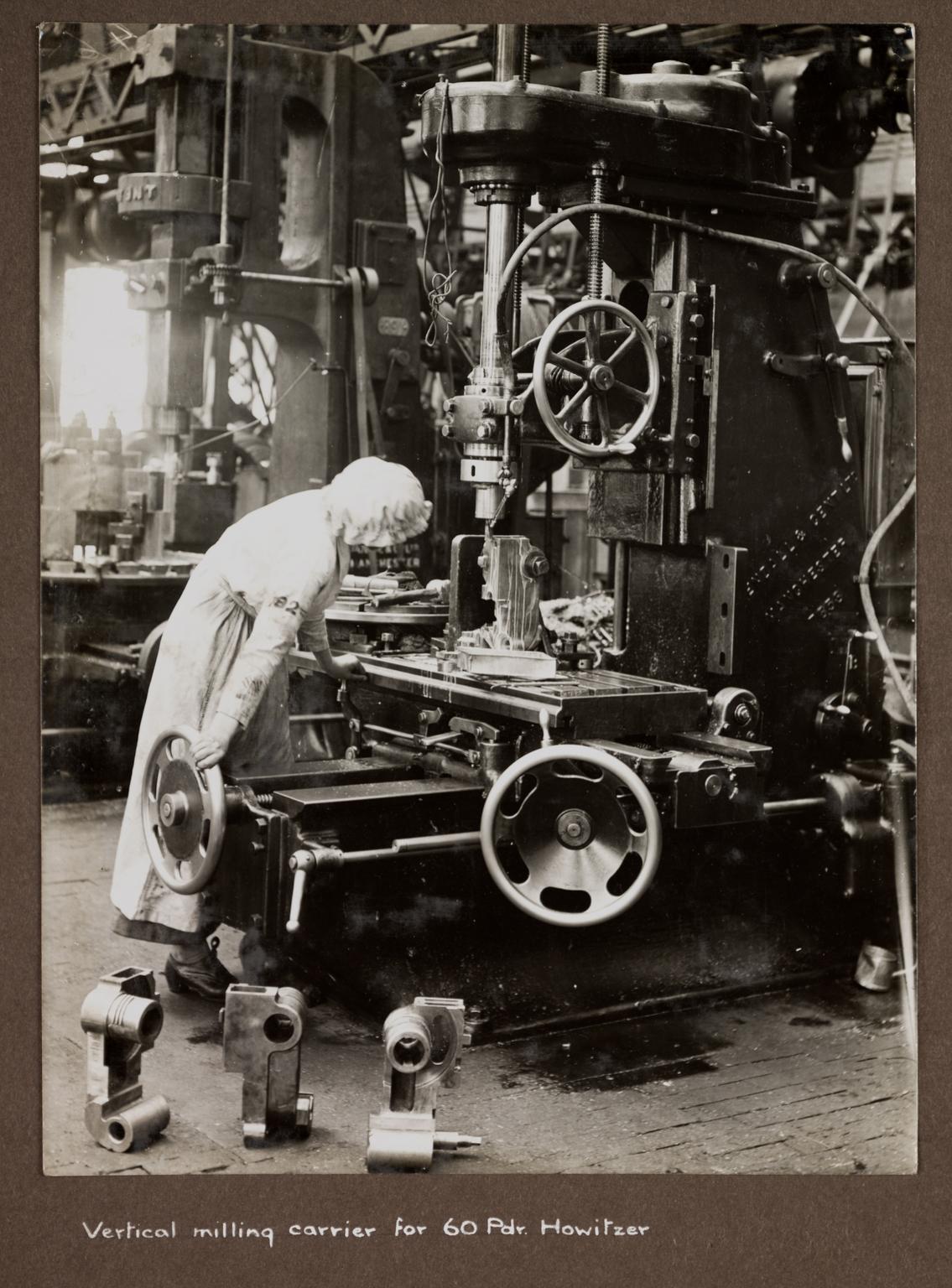
Vertical milling carrier for 60 Pdr. Howitzer

Vertical milling carrier for 60 Pdr. Howitzer

A photograph entitled 'Vertical milling carrier for 60 Pdr. Howitzer', taken by an unknown photographer between 1915 and 1918. The photograph shows a woman operating a vertical milling carrier in a British munitions factory. An armband around her right upper arm reads '82' - this may record her employee number on the factory floor. This photograph is taken from an album entitled 'Women's Work in the War 1915-1918'.

More

A photograph entitled 'Vertical milling carrier for 60 Pdr. Howitzer', taken by an unknown photographer between 1915 and 1918.

The photograph shows a woman operating a vertical milling carrier in a British munitions factory. An armband around her right upper arm reads '82' - this may record her employee number on the factory floor. During the first world war, many British women took up what was traditionally seen as men's work to support the war effort.

This photograph is taken from an album entitled 'Women's Work in the War 1915-1918'.

Materials:
paper
Object Number:
1994-5019/3
type:
photograph
Image ©
The Board of Trustees of the Science Museum
A photograph entitled 'Slotting quadrants for 6" and 8" Howitzer sights: working to finish limits as to thickness and depth of teeth', taken by an unknown photographer between 1915 and 1918. The photograph shows women working at individual stations in a British munitions factory, assembling gun components. Some of the women's overalls are marked with the initials 'PB' - this could be an abbreviated company name. This photograph is taken from an album entitled 'Women's Work in the War 1915-1918'.

Slotting quadrants for 6" and 8" Howitzer sights…

A photograph entitled 'Slotting quadrants for 6" and 8" Howitzer sights: working to finish limits as to thickness and depth of teeth', taken by an unknown photographer between 1915 and 1918. The photograph shows women working at individual stations in a British munitions factory, assembling gun components. Some of the women's overalls are marked with the initials 'PB' - this could be an abbreviated company name. This photograph is taken from an album entitled 'Women's Work in the War 1915-1918'.

More

A photograph entitled 'Slotting quadrants for 6" and 8" Howitzer sights: working to finish limits as to thickness and depth of teeth', taken by an unknown photographer between 1915 and 1918.

The photograph shows women working at individual stations in a British munitions factory, assembling gun components. Some of the women's overalls are marked with the initials 'PB' - this could be an abbreviated company name. During the first world war, many British women took up what was traditionally seen as men's work to support the war effort.

This photograph is taken from an album entitled 'Women's Work in the War 1915-1918'.

Materials:
paper
Object Number:
1994-5019/7
type:
photograph
A photograph entitled 'Fitting yoke of Lewis gun tripod and elevating screw nut', taken by an unknown photographer between 1915 and 1918. The photograph shows women working in a British munitions factory, they sit at stations along a workbench fitting gun components. Various tools and machine parts are readily available on the bench. This photograph is taken from an album entitled 'Women's Work in the War 1915-1918'.

Fitting yoke of Lewis gun tripod and elevating screw nut

A photograph entitled 'Fitting yoke of Lewis gun tripod and elevating screw nut', taken by an unknown photographer between 1915 and 1918. The photograph shows women working in a British munitions factory, they sit at stations along a workbench fitting gun components. Various tools and machine parts are readily available on the bench. This photograph is taken from an album entitled 'Women's Work in the War 1915-1918'.

More

A photograph entitled 'Fitting yoke of Lewis gun tripod and elevating screw nut', taken by an unknown photographer between 1915 and 1918.

The photograph shows women working in a British munitions factory, they sit at stations along a workbench fitting gun components. Various tools and machine parts are readily available on the bench.

During the first world war, many British women took up what was traditionally seen as men's work to support the war effort. This photograph is taken from an album entitled 'Women's Work in the War 1915-1918'.

Materials:
paper
Object Number:
1994-5019/12
type:
photograph
A photograph entitled 'Fitting and lapping flanges and adjustments for wheel of ammunition wagon' taken by an unknown photographer between 1915 and 1918. The photograph shows women working in a British munitions factory, children gather in the background to watch the photographer. This photograph is taken from an album entitled 'Women's Work in the War 1915-1918'.

Fitting and lapping flanges and adjustments…

A photograph entitled 'Fitting and lapping flanges and adjustments for wheel of ammunition wagon' taken by an unknown photographer between 1915 and 1918. The photograph shows women working in a British munitions factory, children gather in the background to watch the photographer. This photograph is taken from an album entitled 'Women's Work in the War 1915-1918'.

More

A photograph entitled 'Fitting and lapping flanges and adjustments for wheel of ammunition wagon' taken by an unknown photographer between 1915 and 1918.

The photograph shows women working in a British munitions factory, children gather in the background to watch the photographer.

During the first world war, many British women took up what was traditionally seen as men's work to support the war effort. This photograph is taken from an album entitled 'Women's Work in the War 1915-1918'.

Materials:
paper
Object Number:
1994-5019/17
type:
photograph
A photograph entitled 'Sandpapering wooden wheel felloes for ammunition wagon', taken by an unknown photographer between 1915 and 1918. The photograph shows two women standing either side of a workstation, sandpapering wheel parts. The notice on the wall behind them says, 'This machine is for the use of this mill only'. This photograph is taken from an album entitled 'Women's Work in the War 1915-1918'.

Sandpapering wooden wheel felloes for ammunition wagon

A photograph entitled 'Sandpapering wooden wheel felloes for ammunition wagon', taken by an unknown photographer between 1915 and 1918. The photograph shows two women standing either side of a workstation, sandpapering wheel parts. The notice on the wall behind them says, 'This machine is for the use of this mill only'. This photograph is taken from an album entitled 'Women's Work in the War 1915-1918'.

More

A photograph entitled 'Sandpapering wooden wheel felloes for ammunition wagon', taken by an unknown photographer between 1915 and 1918.

The photograph shows two women standing either side of a workstation, sandpapering wheel parts. The notice on the wall behind them says, 'This machine is for the use of this mill only'.

During the first world war, many British women took up what was traditionally seen as men's work to support the war effort. This photograph is taken from an album entitled 'Women's Work in the War 1915-1918'.

Materials:
paper
Object Number:
1994-5019/19
type:
photograph
A photograph entitled 'Woman drilling safety hole in fuses', taken by an unknown photographer between 1915 and 1918. The photograph shows a woman working in a British munitions factory, operating a drill. This photograph is taken from an album entitled 'Women's Work in the War 1915-1918'.

Woman drilling safety hole in fuses

A photograph entitled 'Woman drilling safety hole in fuses', taken by an unknown photographer between 1915 and 1918. The photograph shows a woman working in a British munitions factory, operating a drill. This photograph is taken from an album entitled 'Women's Work in the War 1915-1918'.

More

A photograph entitled 'Woman drilling safety hole in fuses', taken by an unknown photographer between 1915 and 1918.

The photograph shows a woman working in a British munitions factory, operating a drill. During the first world war, many British women took up what was traditionally seen as men's work to support the war effort.

This photograph is taken from an album entitled 'Women's Work in the War 1915-1918'.

Materials:
paper
Object Number:
1994-5019/29
type:
photograph
A photograph entitled 'Building small commutators', taken by an unknown photographer between 1915 and 1918. The photograph shows women working, four to five a row, at long benches on a variety of tasks. Some chat while they work. A male supervisor observes the workflow.

Building small commutators

A photograph entitled 'Building small commutators', taken by an unknown photographer between 1915 and 1918. The photograph shows women working, four to five a row, at long benches on a variety of tasks. Some chat while they work. A male supervisor observes the workflow.

The women are building small commutators for use in electric motors. This photograph is taken from an album entitled 'Women's Work in the War 1915-1918'.

More

A photograph entitled 'Building small commutators', taken by an unknown photographer between 1915 and 1918.

The photograph shows women working, four to five a row, at long benches on a variety of tasks. Some chat while they work. A male supervisor observes the workflow. The women are building small commutators for use in electric motors.

During the first world war, many British women took up what was traditionally seen as men's work to support the war effort. This photograph is taken from an album entitled 'Women's Work in the War 1915-1918'.

Materials:
paper
Object Number:
1994-5019/30
type:
photograph
A photograph entitled 'Assembling and fitting valves for large bilge and feed chests' taken by an unknown photographer between 1915 and 1918. The photograph shows women at a workbench in a British factory. A male supervisor looks on. This photograph is taken from an album entitled 'Women's Work in the War 1915-1918'.

Assembling and fitting valves for large bilge and feed chests

A photograph entitled 'Assembling and fitting valves for large bilge and feed chests' taken by an unknown photographer between 1915 and 1918. The photograph shows women at a workbench in a British factory. A male supervisor looks on. This photograph is taken from an album entitled 'Women's Work in the War 1915-1918'.

More

A photograph entitled 'Assembling and fitting valves for large bilge and feed chests' taken by an unknown photographer between 1915 and 1918.

The photograph shows women at a workbench in a British factory. A male supervisor looks on. During the first world war, many British women took up what was traditionally seen as men's work to support the war effort.

This photograph is taken from an album entitled 'Women's Work in the War 1915-1918'.

Materials:
paper
Object Number:
1994-5019/33
type:
photograph
A photograph entitled 'Woman milling ports in steam chest huer. Sets her own work', taken by an unknown photographer between 1915 and 1918. Women working in wartime were often closely directed by male supervisors, but this employee is responsible for setting her own work. This photograph is taken from an album entitled 'Women's Work in the War 1915-1918'.

Woman milling ports in steam chest huer. Sets her own work

A photograph entitled 'Woman milling ports in steam chest huer. Sets her own work', taken by an unknown photographer between 1915 and 1918. Women working in wartime were often closely directed by male supervisors, but this employee is responsible for setting her own work. This photograph is taken from an album entitled 'Women's Work in the War 1915-1918'.

More

A photograph entitled 'Woman milling ports in steam chest huer. Sets her own work', taken by an unknown photographer between 1915 and 1918.

Women working in wartime were often closely directed by male supervisors, but this employee is responsible for setting her own work.

During the first world war, many British women took up what was traditionally seen as men's work to support the war effort. This photograph is taken from an album entitled 'Women's Work in the War 1915-1918'.

Materials:
paper
Object Number:
1994-5019/38
type:
photograph
A photograph entitled 'Grinding cutting edge and lead on screwing die', taken by an unknown photographer between 1915 and 1918. The photograph shows a woman at a workstation in a British factory. This photograph is taken from an album entitled 'Women's Work in the War 1915-1918'.

Grinding cutting edge and lead on screwing die

A photograph entitled 'Grinding cutting edge and lead on screwing die', taken by an unknown photographer between 1915 and 1918. The photograph shows a woman at a workstation in a British factory. This photograph is taken from an album entitled 'Women's Work in the War 1915-1918'.

More

A photograph entitled 'Grinding cutting edge and lead on screwing die', taken by an unknown photographer between 1915 and 1918.

The photograph shows a woman at a workstation in a British factory. During the first world war, many British women took up what was traditionally seen as men's work to support the war effort.

This photograph is taken from an album entitled 'Women's Work in the War 1915-1918'.

Materials:
paper
Object Number:
1994-5019/44
type:
photograph
A photograph entitled 'Grinding teeth of milling cutters. Operator sets own stops', taken by an unknown photographer between 1915 and 1918. The photograph shows a woman at her workstation in a British factory. This photograph is taken from an album entitled 'Women's Work in the War 1915-1918'.

Grinding teeth of milling cutters. Operator sets own stops

A photograph entitled 'Grinding teeth of milling cutters. Operator sets own stops', taken by an unknown photographer between 1915 and 1918. The photograph shows a woman at her workstation in a British factory. This photograph is taken from an album entitled 'Women's Work in the War 1915-1918'.

More

A photograph entitled 'Grinding teeth of milling cutters. Operator sets own stops', taken by an unknown photographer between 1915 and 1918.

The photograph shows a woman at her workstation in a British factory. During the first world war, many British women took up what was traditionally seen as men's work to support the war effort.

This photograph is taken from an album entitled 'Women's Work in the War 1915-1918'.

Materials:
paper
Object Number:
1994-5019/45
type:
photograph
A photograph entitled 'General view of dope room in aircraft factory', taken by an unknown photographer between 1915 and 1918. The photograph shows a large team of women working in a British aircraft factory. The aeroplane frame is covered with fabric and painted with dope, a glue which made the aircraft airtight. Women who worked in this room were sometimes known as 'dopers'. This photograph is taken from an album entitled 'Women's Work in the War 1915-1918'.

General view of dope room in aircraft factory

A photograph entitled 'General view of dope room in aircraft factory', taken by an unknown photographer between 1915 and 1918. The photograph shows a large team of women working in a British aircraft factory. The aeroplane frame is covered with fabric and painted with dope, a glue which made the aircraft airtight. Women who worked in this room were sometimes known as 'dopers'. This photograph is taken from an album entitled 'Women's Work in the War 1915-1918'.

More

A photograph entitled 'General view of dope room in aircraft factory', taken by an unknown photographer between 1915 and 1918.

The photograph shows a large team of women working in a British aircraft factory. The aeroplane frame is covered with fabric and painted with dope, a glue which made the aircraft airtight. Women who worked in this room were sometimes known as 'dopers'.

During the First World War, many British women took up what was traditionally seen as men's work to support the war effort. This photograph is taken from an album entitled 'Women's Work in the War 1915-1918'.

Materials:
paper
Object Number:
1994-5019/46
type:
photograph
A photograph entitled 'Woman operating No.9 Herbert Combination Lathe - finish boring and facing accurately to length cylinders for aero engine', taken by an unknown photographer between 1915 and 1918. the photograph shows a woman working on a machine as a man looks on. Other men in the room look towards the photographer. This photograph is taken from an album entitled 'Women's Work in the War 1915-1918'.

Woman operating No. 9 Herbert Combination Lathe...

A photograph entitled 'Woman operating No.9 Herbert Combination Lathe - finish boring and facing accurately to length cylinders for aero engine', taken by an unknown photographer between 1915 and 1918. the photograph shows a woman working on a machine as a man looks on. Other men in the room look towards the photographer. This photograph is taken from an album entitled 'Women's Work in the War 1915-1918'.

More

A photograph entitled 'Woman operating No.9 Herbert Combination Lathe - finish boring and facing accurately to length cylinders for aero engine', taken by an unknown photographer between 1915 and 1918.

The photograph shows a woman working on a machine as a man looks on. Other men in the room look towards the photographer. During the first world war, many British women took up what was traditionally seen as men's work to support the war effort.

This photograph is taken from an album entitled 'Women's Work in the War 1915-1918'.

Materials:
paper
Object Number:
1994-5019/54
type:
photograph
A photograph entitled 'Operating Potter and Johnson Automatic Lathe - rough boring, facing and finish boring aluminium pistons for Clerget rotary engine', taken by an unknown photographer between 1915 and 1918. The photograph shows a woman working in a British factory, a man works on the machine behind her. This photograph is taken from an album entitled 'Women's Work in the War 1915-1918'.

Operating Potter and Johnson Automatic Lathe…

A photograph entitled 'Operating Potter and Johnson Automatic Lathe - rough boring, facing and finish boring aluminium pistons for Clerget rotary engine', taken by an unknown photographer between 1915 and 1918. The photograph shows a woman working in a British factory, a man works on the machine behind her. This photograph is taken from an album entitled 'Women's Work in the War 1915-1918'.

More

A photograph entitled 'Operating Potter and Johnson Automatic Lathe - rough boring, facing and finish boring aluminium pistons for Clerget rotary engine', taken by an unknown photographer between 1915 and 1918.

The photograph shows a woman working in a British factory, a man works on the machine behind her.

During the first world war, many British women took up what was traditionally seen as men's work to support the war effort. This photograph is taken from an album entitled 'Women's Work in the War 1915-1918'.

Materials:
paper
Object Number:
1994-5019/56
type:
photograph
A photograph entitled 'Fitting Clerget engine cylinder - final fitting before assembling using file, chisel and hammer', taken by an unknown photographer between 1915 and 1918. The photograph shows women working at a workbench in a British factory. This photograph is taken from an album entitled 'Women's Work in the War 1915-1918'.

Fitting Clerget engine cylinder...

A photograph entitled 'Fitting Clerget engine cylinder - final fitting before assembling using file, chisel and hammer', taken by an unknown photographer between 1915 and 1918. The photograph shows women working at a workbench in a British factory. This photograph is taken from an album entitled 'Women's Work in the War 1915-1918'.

More

A photograph entitled 'Fitting Clerget engine cylinder - final fitting before assembling using file, chisel and hammer', taken by an unknown photographer between 1915 and 1918.

The photograph shows women working at a workbench in a British factory.

During the first world war, many British women took up what was traditionally seen as men's work to support the war effort. This photograph is taken from an album entitled 'Women's Work in the War 1915-1918'.

Materials:
paper
Object Number:
1994-5019/57
type:
photograph
A photograph entitled 'Filing split bolt to gauge - limit 0.0001' taken by an unknown photographer between 1915 and 1918. Standing over her workstation, a woman works on filing a machine component. This photograph is taken from an album entitled 'Women's Work in the War 1915-1918'.

Filing split bolt to gauge - limit 0.0001

A photograph entitled 'Filing split bolt to gauge - limit 0.0001' taken by an unknown photographer between 1915 and 1918. Standing over her workstation, a woman works on filing a machine component. This photograph is taken from an album entitled 'Women's Work in the War 1915-1918'.

More

A photograph entitled 'Filing split bolt to gauge - limit 0.000' taken by an unknown photographer between 1915 and 1918.

Standing over her workstation, a woman works on filing a machine component.

During the first world war, many British women took up what was traditionally seen as men's work to support the war effort. This photograph is taken from an album entitled 'Women's Work in the War 1915-1918'.

Materials:
paper
Object Number:
1994-5019/62
type:
photograph
A photograph entitled 'Women making rivets', taken by an unknown photographer between 1915 and 1918. The photograph shows two women making rivets in a British factory. This photograph is taken from an album entitled 'Women's Work in the War 1915-1918'.

Women making rivets

A photograph entitled 'Women making rivets', taken by an unknown photographer between 1915 and 1918. The photograph shows two women making rivets in a British factory. This photograph is taken from an album entitled 'Women's Work in the War 1915-1918'.

More

A photograph entitled 'Women making rivets', taken by an unknown photographer between 1915 and 1918.

The photograph shows two women making rivets in a British factory.

During the first world war, many British women took up what was traditionally seen as men's work to support the war effort. This photograph is taken from an album entitled 'Women's Work in the War 1915-1918'.

Materials:
paper
Object Number:
1994-5019/76
type:
photograph
A photograph entitled 'Woman assisting in the making of rivets', taken by an unknown photographer between 1915 and 1918. The photograph shows a man and a woman making rivets in a British factory. This photograph is taken from an album entitled 'Women's Work in the War 1915-1918'.

Woman assisting in the making of rivets

A photograph entitled 'Woman assisting in the making of rivets', taken by an unknown photographer between 1915 and 1918. The photograph shows a man and a woman making rivets in a British factory. This photograph is taken from an album entitled 'Women's Work in the War 1915-1918'.

More

A photograph entitled 'Woman assisting in the making of rivets', taken by an unknown photographer between 1915 and 1918.

The photograph shows a man and a woman making rivets in a British factory. During the first world war, many British women took up what was traditionally seen as men's work to support the war effort.

This photograph is taken from an album entitled 'Women's Work in the War 1915-1918'.

Materials:
paper
Object Number:
1994-5019/77
type:
photograph
A photograph entitled 'Hand moulding ring cores', taken by an unknown photographer between 1915 and 1918. The photograph shows two women at work in a British factory. This photograph is taken from an album entitled 'Women's Work in the War 1915-1918'.

Hand moulding ring cores

A photograph entitled 'Hand moulding ring cores', taken by an unknown photographer between 1915 and 1918. The photograph shows two women at work in a British factory. This photograph is taken from an album entitled 'Women's Work in the War 1915-1918'.

More

A photograph entitled 'Hand moulding ring cores', taken by an unknown photographer between 1915 and 1918.

The photograph shows two women at work in a British factory. During the first world war, many British women took up what was traditionally seen as men's work to support the war effort.

This photograph is taken from an album entitled 'Women's Work in the War 1915-1918'.

Materials:
paper
Object Number:
1994-5019/80
type:
photograph
A photograph entitled 'Women engaged in the analysis of copper', taken by an unknown photographer between 1915 and 1918. The photograph shows three women analysing copper. This photograph is taken from an album entitled 'Women's Work in the War 1915-1918'.

Women engaged in the analysis of copper

A photograph entitled 'Women engaged in the analysis of copper', taken by an unknown photographer between 1915 and 1918. The photograph shows three women analysing copper. This photograph is taken from an album entitled 'Women's Work in the War 1915-1918'.

More

A photograph entitled 'Women engaged in the analysis of copper', taken by an unknown photographer between 1915 and 1918.

The photograph shows three women analysing copper. During the first world war, many British women took up what was traditionally seen as men's work to support the war effort.

This photograph is taken from an album entitled 'Women's Work in the War 1915-1918'.

Materials:
paper
Object Number:
1994-5019/85
type:
photograph
A photograph entitled 'Operating bar lathes on machine tool parts', taken by an unknown photographer between 1915 and 1918. The photograph shows a woman operating machinery in a British factory. This photograph is taken from an album entitled 'Women's Work in the War 1915-1918'.

Operating bar lathes on machine tool parts

A photograph entitled 'Operating bar lathes on machine tool parts', taken by an unknown photographer between 1915 and 1918. The photograph shows a woman operating machinery in a British factory. This photograph is taken from an album entitled 'Women's Work in the War 1915-1918'.

More

A photograph entitled 'Operating bar lathes on machine tool parts', taken by an unknown photographer between 1915 and 1918.

The photograph shows a woman operating machinery in a British factory. During the first world war, many British women took up what was traditionally seen as men's work to support the war effort.

This photograph is taken from an album entitled 'Women's Work in the War 1915-1918'.

Materials:
paper
Object Number:
1994-5019/86
type:
photograph
A photograph entitled 'Woman hardening tools' taken by an unknown photographer between 1915 and 1918. The photograph shows a woman working in a British factory. This photograph is taken from an album entitled 'Women's Work in the War 1915-1918'.

Woman hardening tools

A photograph entitled 'Woman hardening tools' taken by an unknown photographer between 1915 and 1918. The photograph shows a woman working in a British factory. This photograph is taken from an album entitled 'Women's Work in the War 1915-1918'.

More

A photograph entitled 'Woman hardening tools' taken by an unknown photographer between 1915 and 1918.

The photograph shows a woman working in a British factory. During the first world war, many British women took up what was traditionally seen as men's work to support the war effort.

This photograph is taken from an album entitled 'Women's Work in the War 1915-1918'.

Materials:
paper
Object Number:
1994-5019/92
type:
photograph
A photograph entitled 'Filing up induction pipes, cylinder webs, aluminium pistons etc', taken by an unknown photographer between 1915 and 1918. The photograph shows a team of women working in a British factory. This photograph is taken from an album entitled 'Women's Work in the War 1915-1918'.

Filing up induction pipes, cylinder webs, aluminium pistons etc

A photograph entitled 'Filing up induction pipes, cylinder webs, aluminium pistons etc', taken by an unknown photographer between 1915 and 1918. The photograph shows a team of women working in a British factory. This photograph is taken from an album entitled 'Women's Work in the War 1915-1918'.

More

A photograph entitled 'Filing up induction pipes, cylinder webs, aluminium pistons etc', taken by an unknown photographer between 1915 and 1918.

The photograph shows a team of women working in a British factory. During the first world war, many British women took up what was traditionally seen as men's work to support the war effort.

This photograph is taken from an album entitled 'Women's Work in the War 1915-1918'.

Materials:
paper
Object Number:
1994-5019/93
type:
photograph
A photograph entitled 'At labouring work in Dressing Shop', taken by an unknown photographer between 1915 and 1918. The photograph shows a group of women and a man moving bricks and rubble. This photograph is taken from an album entitled 'Women's Work in the War 1915-1918'.

At labouring work in Dressing Shop

A photograph entitled 'At labouring work in Dressing Shop', taken by an unknown photographer between 1915 and 1918. The photograph shows a group of women and a man moving bricks and rubble. This photograph is taken from an album entitled 'Women's Work in the War 1915-1918'.

More

A photograph entitled 'At labouring work in Dressing Shop', taken by an unknown photographer between 1915 and 1918.

The photograph shows a group of women and a man moving bricks and rubble. During the first world war, many British women took up what was traditionally seen as men's work to support the war effort.

This photograph is taken from an album entitled 'Women's Work in the War 1915-1918'.

Materials:
paper
Object Number:
1994-5019/99
type:
photograph
A photograph entitled 'Excavating in deep cutting', taken by an unknown photographer between 1915 and 1918. The photograph shows a group of men, women and children digging a deep cutting. This photograph is taken from an album entitled 'Women's Work in the War 1915-1918'.

Excavating a deep cutting

A photograph entitled 'Excavating in deep cutting', taken by an unknown photographer between 1915 and 1918. The photograph shows a group of men, women and children digging a deep cutting. This photograph is taken from an album entitled 'Women's Work in the War 1915-1918'.

More

A photograph entitled 'Excavating in deep cutting', taken by an unknown photographer between 1915 and 1918.

The photograph shows a group of men, women and children digging a deep cutting. During the first world war, many British women took up what was traditionally seen as men's work to support the war effort.

This photograph is taken from an album entitled 'Women's Work in the War 1915-1918'.

Materials:
paper
Object Number:
1994-5019/104
type:
photograph