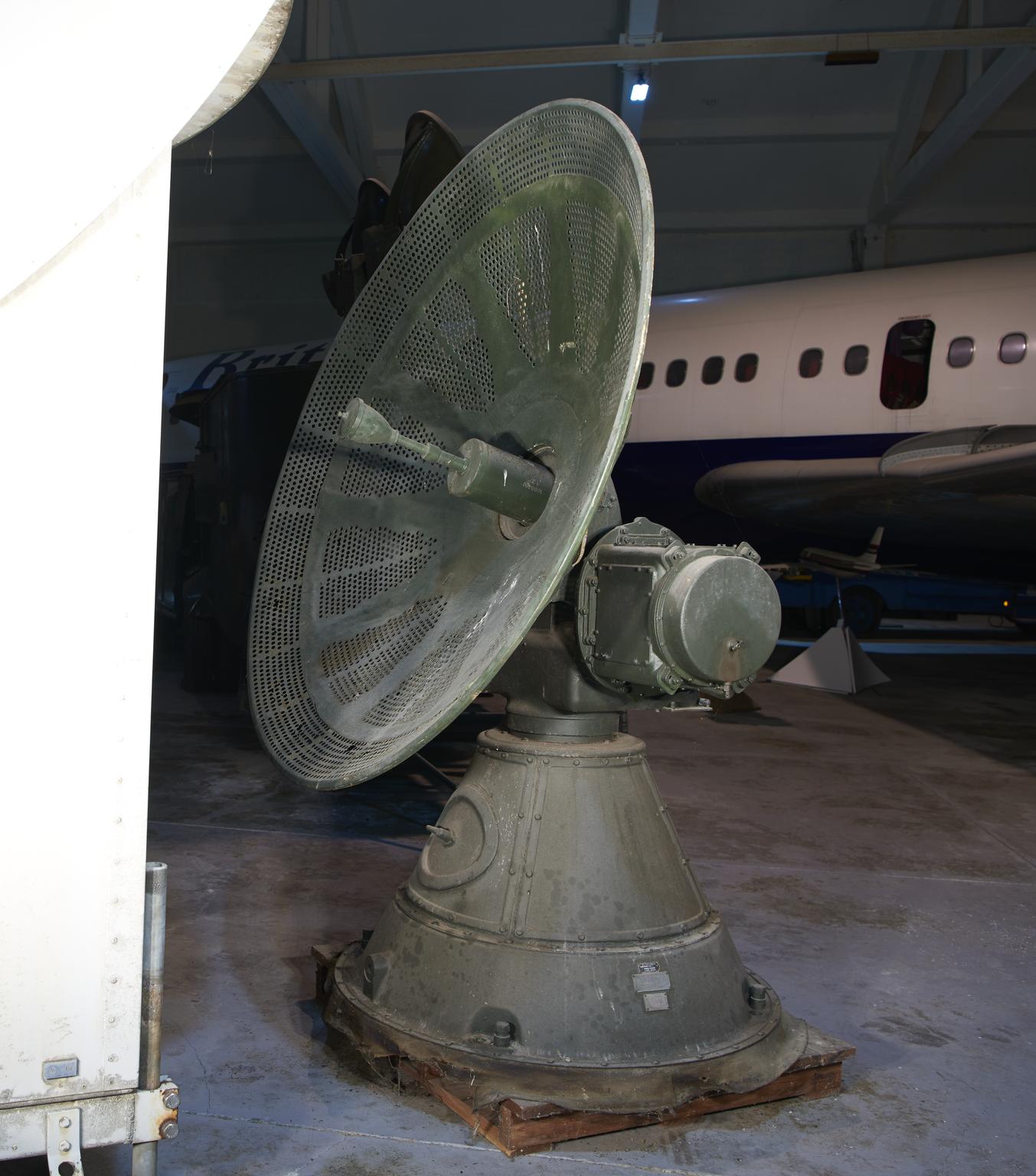
Aerial assembly component for SCR-584 radar, c.1944
Part for aerial assembly and pedestal from SCR-584, radar, c. 1944. The SCR-584 radar used conical scan tracking—in which a single offset (squinted) radar beam is continuously rotated about the radar antenna’s central axis—and, with its four-degree beamwidth, it had sufficient angular accuracy to place antiaircraft guns on target without the need for searchlights or optics, as was required for older radars with wider beamwidths such as the SCR-268. The SCR-584 operated in the frequency range from 2.7 to 2.9 GHz (known as the S band) and had a parabolic reflector antenna with a diameter of nearly 6.6 feet (2 metres).
One of the most notable microwave radars developed by the MIT Radiation Laboratory was the SCR-584, a widely used gunfire-control system. SCR-594 was first used in combat early in 1944 on the Anzio beachhead in Italy. Its introduction was timely, since the Germans by that time had learned how to jam its predecessor, the SCR-268. The introduction of the SCR-584 microwave radar caught the Germans unprepared.