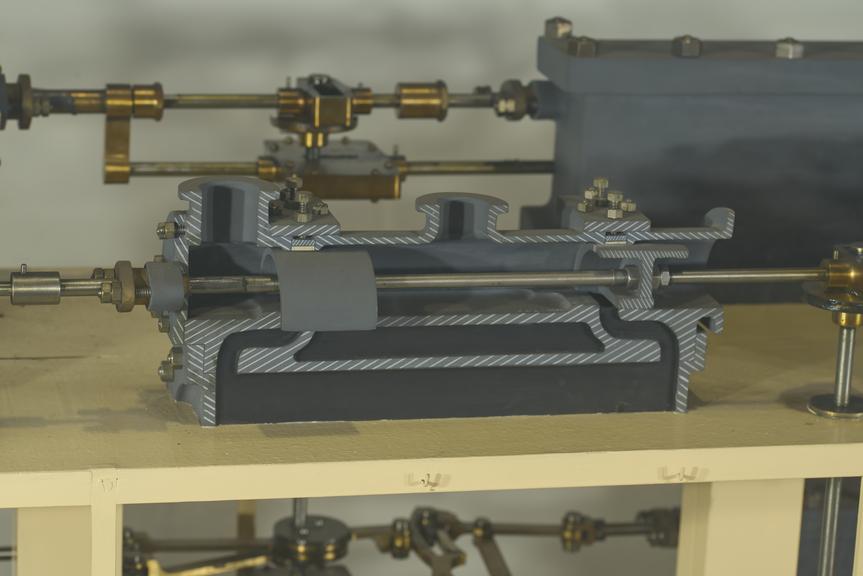
Representative sectional model of Short D simple slide valve. Arranged with 7 others
- maker:
- Science Museum, Workshops
 This image is released under a CC BY-NC-SA 4.0
Licence
This image is released under a CC BY-NC-SA 4.0
Licence
License this image for commercial use at Science and Society Picture Library
License
Science Museum Group
© The Board of Trustees of the Science Museum
Representative sectional model of Short D simple slide valve. Arranged with 7 others, in 2 rows of 4 each on a special fitting for driving by a winch handle
This series of eight models shows various modifications that have been employed in this type of valve since its original introduction at the end of the 18th century, c.f., William Murdock's models of an oscillating engine and a steam carriage. As a sliding valve may continue its movement after it has closed any particular passage which it controls, it may be so arranged as to open or close other passages, simultaneously or otherwise, and thus combine the duties of several valves. Owing to this feature a single slide valve replaced the four beat valves which were originally necessary in the early double-acting steam engines, and this simplicity, combined with quietness in working, has since led to the general adoption of the slide valve in nearly all classes of steam engines. The valves illustrated are:- long D, short D, common or locomotive, piston, double-ported, Trick's, Church's and Hackworth's.
Details
- Category:
- Motive Power
- Object Number:
- 1902-156
- Materials:
- metal (unknown)
- Measurements:
-
Case: 1260 mm x 1960 mm x 1000 mm,
- type:
- model