 This image is released under a CC BY-NC-SA 4.0
Licence
This image is released under a CC BY-NC-SA 4.0
Licence
License this image for commercial use at Science and Society Picture Library
License
Science Museum Group
© The Board of Trustees of the Science Museum
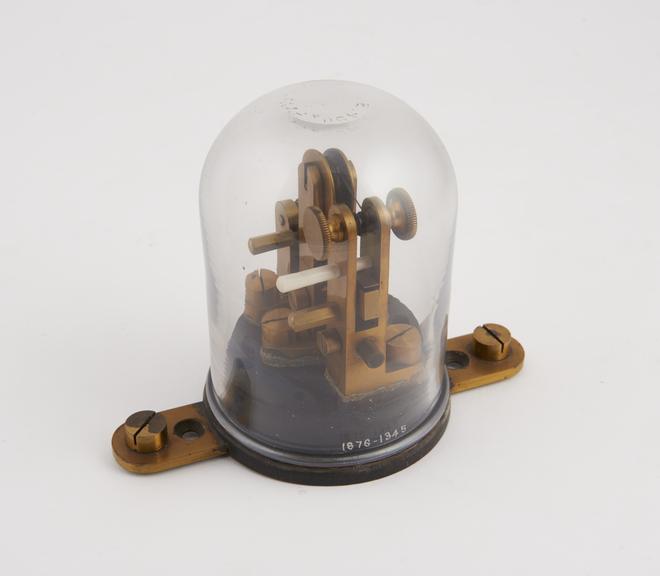
This lighting protector was built in Russia at some point in the late 19th century and was used by the Russian Imperial Telegraph Office.
The protector has a mostly cylindrical glass casing which covers the internal circuit and lever mechanism from weather. The device would be connected to a circuit by having wires attached to metal conductors positioned either side of the protector’s oak base. The lever mechanism and conductors are mostly made of brass with some steel parts.
Lightning protectors are also referred to as lightning arrestors or isolators, are used to protect and mitigate damage to telecommunication systems and the electric grid from lightning strikes.
When lightning strikes power or telegraph lines, the surge of power could often seriously damage electric equipment such as telegraph relays and the people who operated them. To prevent this, lightning protectors like this one were attached to the lines, and when lighting struck it is detected by the protector, activating a spring which would press down a brass lever which diverts the power surge to the earth redirecting the surge and preventing damage or valuable electrical equipment.
This lighting protector was built to protect aerial telegraph cables in Russia during the late 19th century, specifically by the Russian Imperial Telegraph Office. It is also part of original ‘Special Loan Collection of Scientific Apparatus at the South Kensington Museum’ from 1876, making it among the very first objects collection by the SMG to represent international scientific innovations.
Details
- Category:
- Geophysics
- Object Number:
- 1876-1345
- Materials:
- asbestos, brass (copper, zinc alloy), steel (metal), glass and oak (wood)
- type:
- telegraph
- credit:
- General Director of Russian Telegraphs
Related Objects
Photograph of Askania Z-beam torsion balance

Record of Gravity Determinations Made By a Dutch Submarine