Diagram of Stierle gauge, 1886
- Made:
- 1927 in United Kingdom
- maker:
- Unknown
This diagram was commissioned by the Science Museum Group in 1927 to depict Stierle's design for a self-registrating tide gauge developed in 1886.
In 1886 Andreas Stierle, Assistant to the U.S. Engineer Department, developed a type of tide gauge which could self-register and record tidal measurements automatically. This design was developed as an improvement of an earlier tide gauge designed by Saxton in 1853.
This tide gauge worked by having its float attached to a pull wire, which has a pencil connected to it. As the tide goes up and down, the float moves up and down, which in turn pulls the wire and pencil in different directions. The moving pencil would mark paper chart wrapped around a slowly moving mechanical drum, creating a continuous graph showing the rise and fall of the tide.
Whilst this design initially only saw use by the U.S. Coast and Geodetic Survey, its design quickly spread across the world.
Details
Parts
Related Objects
Thyssen gravity meter with accessories
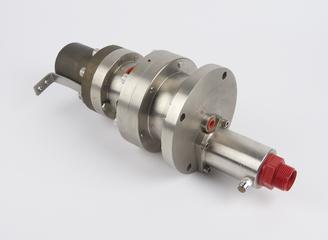
Air Gun for Marine Seismic Surveys, 1970

Telegraph line lightning protector, Russian
Three GAD swamp geophones