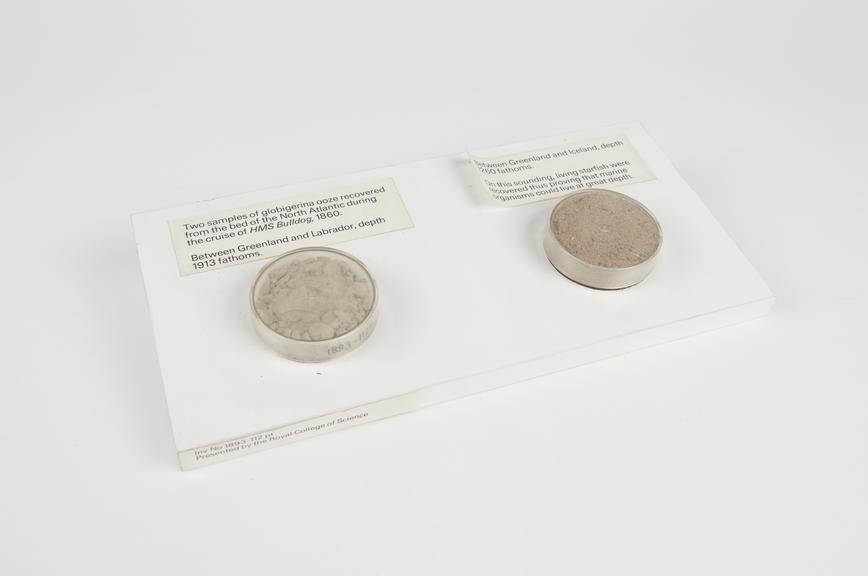
Sample of surface layer of Globigerina ooze collected by HMS Bulldog, 1860
- Made:
- 1860 in North Atlantic Ocean
- maker:
- Unknown
 This image is released under a CC BY-NC-SA 4.0
Licence
This image is released under a CC BY-NC-SA 4.0
Licence
License this image for commercial use at Science and Society Picture Library
License
Science Museum Group
© The Board of Trustees of the Science Museum
Sample of surface layer of Globigerina ooze with unbroken specimens of Foraminifera, collected by HMS Bulldog from the ocean bottom, depth 1260 fathoms, between Greenland and Iceland, North Atlantic Ocean, 1860. This sample is from the sounding in which naturalist George Charles Wallich found living starfish on the ocean floor – demonstrating, for the first time, that life could exist at the bottom of the ocean.
In 1860, the paddle steamer HMS Bulldog was conducting telegraph survey operations around the Faroe Islands, Iceland and Greenland, collecting samples from the sea bottom to investigate the feasibility for a new submarine cable to be laid. The soundings suggested that there might be living organisms at great depths, fuelling an ongoing debate about whether the deep sea did harbour life or whether it was azoic.
Details
- Category:
- Oceanography
- Object Number:
- 1893-112/9
- Materials:
- clay (unfired)
- Measurements:
-
overall: 60 mm x 50 mm x 50 mm, .05 kg
- credit:
- Royal College of Science (Geological Laboratory)
Related Objects
Insulated Waterbottle
Ekman Current Meter
Globe showing land and submarine topography