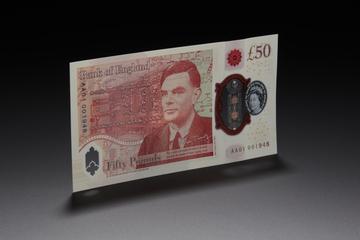
Alan Turing 1912 - 1954
- occupation:
- Computer scientist, Mathematician
- Nationality:
- British
- born in:
- Greater London, England, United Kingdom
Alan Turing, computing pioneer and mathematician, is one of the world’s most influential scientists whose groundbreaking work shaped all our lives. He is recognised for laying the groundwork for the invention of the modern computer and his code-breaking efforts during the Second World War.
Alan Turing (1912- 1954) from an early age was very talented at mathematics. In 1935, while studying at Kings College in Cambridge, Turing’s lecturer, topologist Maxwell Herman Alexander Newman, introduced him to the question of decidability, known as the Entscheidungsproblem. Turing was determined to tackle the challenge, resulting in him writing the paper “On Computable Numbers, with an Application to the Entscheidungsproblem”. This paper lays down the groundwork for the Turing Machine. The Turing Machine describes a computer in its simplest form, beginning with an understanding of the capabilities of a modern computer and exploring the possibility of a machine that could store and read instructions carrying out computable tasks.
During the Second World War, Turing worked at Bletchley Park, the Government Communication Headquarters (GCHQ). Turing’s role was to decrypt German communications made by the text-scrambling Enigma Machines. He applied himself and devised electronic machines to crack the codes which became known as Bombes. It is estimated that Turing’s work and that of the team at Bletchley Park shortened the war by several years, contributing to the Allies winning the war and saving millions of lives in the process. After his time stationed at GCHQ, Turing continued to contribute to early computing efforts.
Turing lived in Manchester from 1948 until his death in 1954. He continued his innovative work in computing and artificial intelligence, becoming Deputy Director of the Computing Laboratory at the University of Manchester. He worked with the world's first stored program computer, the Small Scale Experimental Machine (also known as Baby). Turing, with a team of scientists, developed the programming for the Ferranti Mark 1 the world's first commercially available computer.
In 1952, at time when homosexuality was a criminal office in UK law, Turing was his arrested for having a sexual relationship with a man. He was brought to trial and convicted of gross indecency. Turing suffered tremendously for this. Two years later, on 7 June 1954, shortly before his 42nd birthday, Turing ingested a large amount of cyanide solution at his home in Wilmslow and was found dead the next day. The coroner recorded a verdict of suicide, although the full circumstances of Turing’s death remain unclear. In 2013 Turing was granted a posthumous royal pardon and the UK government recognised the discriminatory and unjust treatment he received under the laws of the time.
Turing has left behind an impressive legacy, not limited to his work in computer science and artificial intelligence. He wrote a founding paper on modern non-linear dynamical theory. He worked on morphogenetic theory and the Fibonacci sequence. His name lives on in the ‘Turing Test’: a test of a machine's ability to exhibit intelligent behaviour equivalent to, or indistinguishable from, that of a human, and ‘Turing’s Law’: an informal term for an amendment in the Policing and Crime Act 2017, granting automatic pardons to those who were convicted of sexual acts that are no longer deemed criminal.
Related Objects
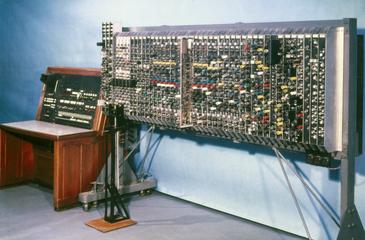
Automatic Computing Engine (ACE) pilot model, 1949
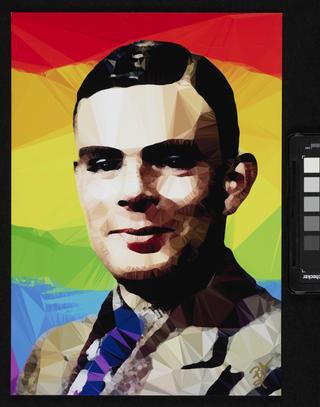
Alan Turing (II), by Baiba Auria

Loebner Prize
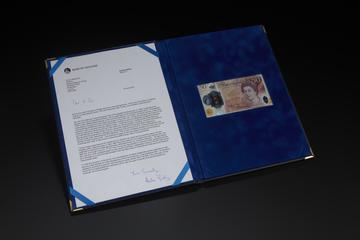
£50 banknote with letter and presentation folder
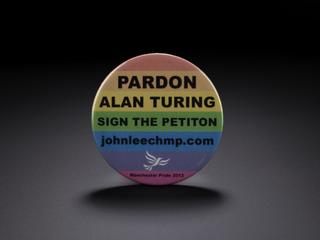
Alan Turing pardon campaign badge
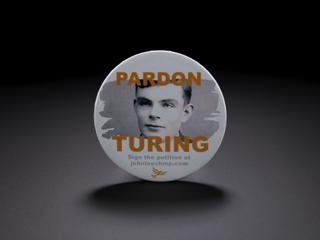
Alan Turing pardon campaign badge
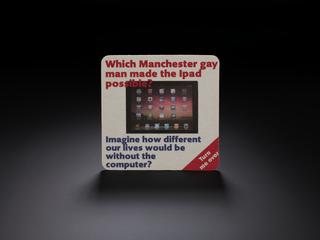
Alan Turing pardon campaign beer mat
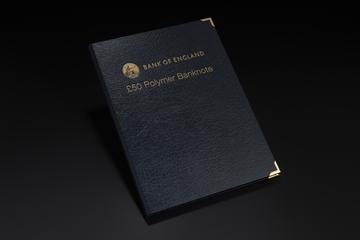
Presentation folder accompanying £50 banknote
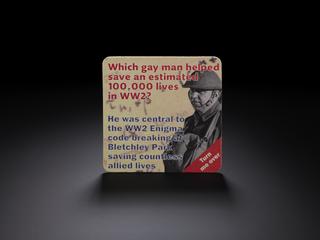
Alan Turing pardon campaign beer mat
