Image
Category
Collection
Maker
On Display
Object type
Place
Material
Date
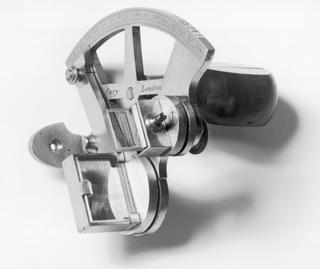
Surveyor's pocket sextant.

Surveyor's pocket sextant.

1795-1805

Slide rule for exchange of weights and measures

Slide rule for exchange of weights and measures

1815

Wollaston slide rule of chemical equivalents, 1814.

Wollaston slide rule of chemical equivalents, 1814.

1814

Combined Abney Level and Clinometer, 1875-1885

Combined Abney Level and Clinometer, 1875-1885

1875-1885

Roget's log-log slide rule

Roget's log-log slide rule

Box type pocket sextant.

Box type pocket sextant.

1845-1855

Marquois scales

Marquois scales

Hunter type clinical thermometer

Hunter type clinical thermometer

1791-1820

Brass Cary pocket microscope

Brass Cary pocket microscope

circa 1789-circa 1825

Early set of drawing instruments by William Cary

Early set of drawing instruments by William Cary

1795-1825

Goniometer

Goniometer

Naturalist's telescope by William Cary

Naturalist's telescope by William Cary

1790-1810

Universal equinoctial ring sundial signed "Cary London"

Universal equinoctial ring sundial signed "Cary London"

1789-1891

Prismatic compass & clinometer, British, 1801-1830

Prismatic compass & clinometer, British, 1801-1830

1801-1830

Photomicrographic camera

Photomicrographic camera

Two double sided inscribed rules

Two double sided inscribed rules

1815

Gould-type microscope in mahogany case lined with velvet

Gould-type microscope in mahogany case lined with velvet

1851-1870

Station pointer

Station pointer

1801-1900

Wollaston scale of chemical equivalents, William Cary, 1814

Wollaston scale of chemical equivalents, William Cary, 1814

1914

Bevan's engineer's slide rule

Bevan's engineer's slide rule

Six's deep sea thermometer by William Cary

Six's deep sea thermometer by William Cary

1800-1899

Sliding parallel rule:- 3 foot

Sliding parallel rule:- 3 foot

Brass framed quintant.

Brass framed quintant.

1880-1890

Compound monocular microscope by Cary

Compound monocular microscope by Cary

1800-1825

Capt. George portable barometer by William Cary

Capt. George portable barometer by William Cary

Brass framed sounding quintant.

Brass framed sounding quintant.

1885-1891

Wollaston type reflecting goniometer with descriptive pamphlet

Wollaston type reflecting goniometer with descriptive pamphlet

1801-1820

Brass die with corresponding  paper conversion scale

Brass die with corresponding paper conversion scale

1816

Ten inch station pointer by William Cary

Ten inch station pointer by William Cary

1801-1851

Brass die for printing conversion scales, William Cary, 1816

Brass die for printing conversion scales, William Cary, 1816

1816

Pantograph in box

Pantograph in box

1791-1851

Gould microscope small size

Gould microscope small size

1801-1830

Wollaston's polariscope No. 948

Wollaston's polariscope No. 948

1850-1899 (estimated)

Slide rule

Slide rule

Brass instrument, inscribed: F L Wollaston/Shirley Warren/Southampton

Brass instrument, inscribed: F L Wollaston/Shirley Warren/Southampton

Three foot scale

Three foot scale

A revolution counter, marked Cary/London

A revolution counter, marked Cary/London

4.5 inch station pointer by Cary

4.5 inch station pointer by Cary

1851-1900

Double Slide Rule (dated 1815), inscribed on one side EXCHANGES BULLION ETC; PULISHED BY W.CARY - 182 STRAND, APR.1.1815; on other side WEIGHTS AND MEASURES AND COINS; PUBLISHED BY W. CARY - 182 STRAND, APR.24.1.1815. Printed on paper, varnished and mounted on mahogany

Double Slide Rule (dated 1815)

1815-1820

Altazimuth theodolite by William Cary, London, 19th century

Altazimuth theodolite by William Cary with fitted wooden box

1801-1900

Portable Universal Ring sundial, by William Cary, London, with wood and cord suspension, in fitted wooden case

Portable Universal Ring sundial

1789-1891

Wollaston's reflecting goniometer, circle (8") in mahogany case (no key), by William Cary, London early 19th century. Donor's name on printed descriptive labels to be, at their request, in full and in order as follows: - Mrs. Madoline Phillips Field and Mrs Anna Phillips Lane

Wollaston's reflecting goniometer

1801-1820

10 inch transit theodolite by William Cary, early 19th century

10 inch transit theodolite by William Cary

1801-1850

Brass sextant with lacquered frame and limb, wooden handle and fitted with artificial horizon invented by Alexander Bridport Becher in 1834, and made by William Cary, London, England, 1835-45. Consists of inlaid polished silver 126° scale (-5° to 150°) with 20’ divisions and silver vernier (20”), three index-filter shades (red & 2 green), three horizon filters (red & green), scale magnifier on 55mm swivelling arm. Fitted with threaded telescope bracket for sighting telescopes (151mm – inverted image). The horizon consists of a 93-mm-long anodized brass tube with a bracket for attaching it to the sextant. The tube contains a pendulum that is lowered into a conical attachment (missing) filled with almond oil to dampen the pendulum's movement. A separate oil lamp (missing) can be fixed to the bracket for illumination at night.

Brass sextant with pendulum artificial horizon.

1835-1845

Double barrelled air pump by William Cary, London, 1801-1900 (see note)

Double barrelled air pump by William Cary

1801-1900

Double sounding quintant invented by Rear-Admiral Frederick Beechey, and made by William Cary, London, about 1847. Anodized brass frame, polished brass limb, a circular brass handle. Signed on the limb: Cary, London. Marked on the limb: Da.96. Inlaid silver scale with two graduations, the lower from the left from -35° to 165° every 30', measuring to 145°; the upper, from the right, from -15° to 155°, measuring to 158°. Two silver verniers to 1'; zero at the left (lower) and at the right (upper). The lower tangent screw and clamping screw are on the back of the index arm, which is on the back of the frame; the upper tangent screw is on the back of the index arm, the clamping screw is on the front. No shades. Two index glasses, adjustment by screws, one horizon glass with two silvered portions and clear glass in between; adjustment by a screw and a capstan screw. Threaded telescope bracket; perpendicular adjustment by rising-piece. Telescope (70 mm) erect image. No box.

Double sounding quintant.

1845-1850

Circular reflecting protractor and accessories by by William Cary, London, England,1801-1825

Circular reflecting protractor, British, 1801-1825

1801-1825

Quintant made by (William) Cary, London, about 1890. Anodized brass straight-bar pattern frame; polished limb, a wooden handle with a brass-lined hole for placing it on a stand. Signed on the limb: Cary, London. Marked on the limb: Platina. Marked on the centre strut: HO [broad anchor] 12. Inlaid platinum scale from -5° to 160° every 10', measuring to 148°. Gold vernier to 10", zero at the right. The tangent screw and clamping screw are on the back of the index arm. Four shades (all grey/green); three horizon shades (all grey/green). Index-glass adjustment by capped screw; adjustment of the horizon glass by a capped screw and a capped thumb screw. Magnifier on a 80 mm swivelling arm. Threaded telescope bracket in two parts, fitted for correcting collimation error; perpendicular adjustment by rising-piece and a milled knob. Telescope (171 mm) inverted image, four cross-wires. An anodized brass column on a tripod stand with three milled levelling screws, for mounting the quintant. The counterbalanced swinging mount can be locked into the desired position by milled screws. Wth wooden carrying case.

Brass framed quintant, with carrying case.

1885-1891

Gould type pocket microscope, by William Cary, London, in mahogany case with accessories: 2 bone slides, tweezers, probe, ivory handled knife and probe, 3 objective lenses and hand lens and glass aquatic slide (modern ?), c. 1830

Gould type pocket microscope

Universal inclining sundial by William Cary, London, in original case, c.1800 .

Universal inclining sundial by William Cary

1789-1891