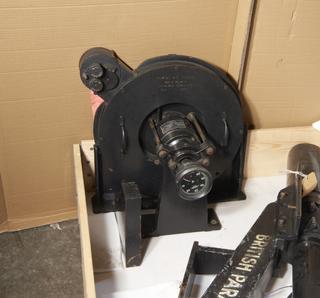
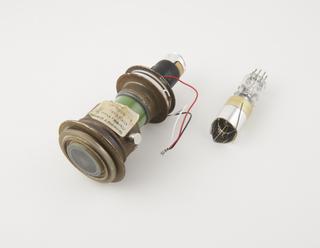
SEC vidicon camera tube - identical to one used in IUE (international ultra-violet explorer) satellite 1972
Prometheus drone, made up of four propellers, raspberry pi microcontroller with cable, motor control box with cable, plastic box with PCB inside and push button with wires. Manufactured by Headlight AI and the University of Manchester, London, 2022. Prometheus Drone 2022
Automatic Train Protection/Automatic Train Operation switch assembly taken from a train using the AutoHaul system, developed by Rio Tinto Iron Ore WA and Hitachi Rail STS, on Rio Tinto's Pilbara iron-ore railway network - the world’s first automated heavy-haul freight railway (fully driverless operation with no crew on board). Once a train has been prepared for the trunk haul, the set-up driver contacts the control centre, establishes a data connection and switches over to automatic operation. The driver then leaves the cab and enables the ATO using an external switch, leaving the control system to dispatch the train at the appropriate time. To ensure safety, locomotives operating automatically display blue lights on the roof. Rio Tinto completed the transition to entirely automated operation of its 1500km railway in the Pilbara region of Western Australia, becoming the first heavy-haul railway in the world to operate an automated network. Described by Rio Tinto as the world’s largest robot, AutoHaul is operating up to 50 automated and unmanned trains at any one time. Each 240-wagon, 2.4km-long consist, requires two to three locomotives, which haul 28,000 tonnes of iron-ore from the company’s 16 mines to the ports of Dampier and Cape Lambert on an average 800km, 40-hour journey. Automatic Train Protection/Automatic Train Operation Switch Assembly, Rio Tinto Pilbara Iron-Ore Railway Network 2018
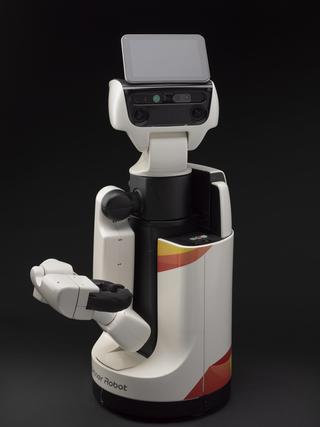
Human Support Robot, by Toyota Motor Corporation, Japan, 2012. Built under their ‘Robot Partners’ programme. Human Support Robot, built under their ‘Robot Partners’ programme 2012
Soft x-ray microscope using zone plate focussing, made at King's College, London, England, in about 1985 and used on a beam line of the Daresbury synchrotron radiation source until about 1997. Soft X-Ray Microscope, 1986 1986
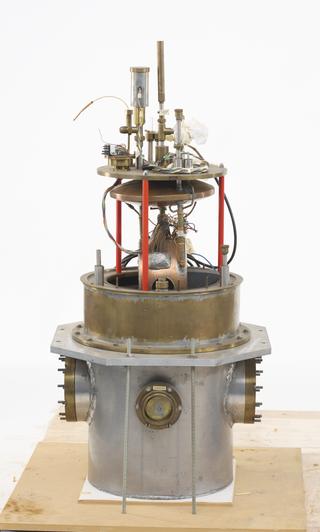
4 MeV electron linear accelerator built by D.W. Fry et al, c. 1948. Ancillary - equipment: IONISATION GAUGE CONTROL UNIT model 3. Made in England by Edwards High Vacuum Ltd., Crawley, Sussex. 4 MeV electron linear accelerator built by D.W. Fry et al 1947