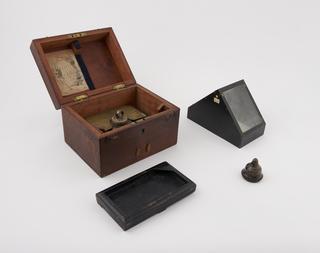
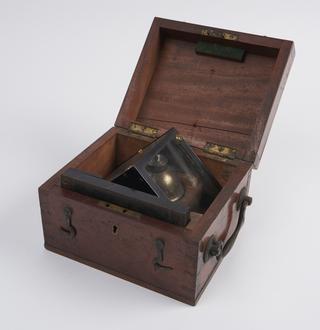
Brass lacquered sextant with straight-bar-pattern, 24 pillar frame, polished brass limb, wooden handle with counterbalanced tripod pillar stand and mercury artificial horizon in wooden box, all by John and Edward Troughton, 136 Fleet Street , London, England, 1790-1800. Consists of brass 127° scale (-5° to 140°) with 20’ divisions and brass vernier (10”), three index-filter shades (red & green), two horizon filters (red & green), scale magnifier on 90mm swivelling arm. Fitted with threaded telescope bracket for sighting telescope (182mm – inverted image) with 2 extra draw tubes, 131mm sighting tube and other accessories. The fitted rectangular case has in the lid the trade card for J. & E. Troughton. The artificial mercurial horizon consisting of a rectangular wooden trough fitted in a tin tray and a brass-framed, roof-shaped cover with glazed side panels, unsigned, made later, 1845-55. Brass framed sextant with stand, artificial horizon and case. 1790-1800
Artificial mercury horizon with fitted leather carrying case, designed by Captain Christopher, provisionally patented in 1868 (No.2624), by the company of William Cary, 1868-1875. Consists of two black-lacquered steel mercury holders on three levelling feet, interconnected by a tube fitted with a stopcock. One is a storage reservoir with a valve to admit air and empty the mercury into the other, which is used for making observations and is fitted with a glass cover. A spare glass cover in a chamois leather pouch, and a lever pin for operating the stopcock (both stored in the glass-covered reservoir). Artificial mercury horizon. 1865-1875
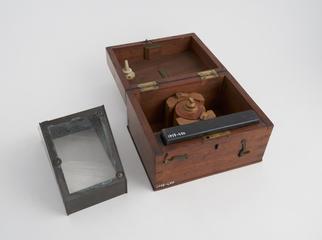
Artificial mercury horizon with mercury container and storage case with trade card, made by Thomas Jones, 62 Charing Cross, London, 1835-1845. Consists of a rectangular metal trough, with wooden lining, and loose fitting roof-shaped brass cover with side glazed panels. The mercury bottle is a flat wooden container with wood screw stopper. Marked, ‘F.26.’ the property mark of the Hydrographic Office of the British Admiralty (adopted February 1828). Artificial mercury horizon. 1835-1845
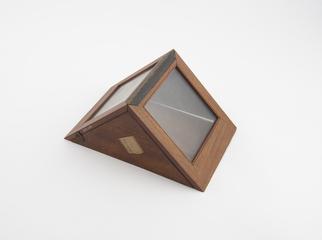
Artifical horizon and cover with boxwood mercury bottle for 18-inch reflecting circle Artificial mercury horizon for reflecting circle. 1790-1826