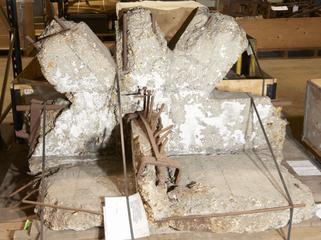
Reinforcement from the 1909 "Hennebique System" Michelin Building, Fulham Road - a cranked beam bar and four small stirrups Reinforced concrete foundation before 1909
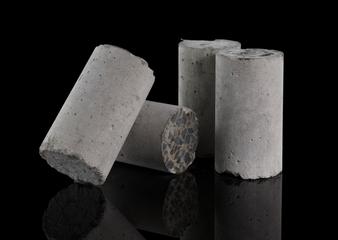
Four pieces of 12th century concrete. These are fragment from a cast stone lintel at Carcassone Four pieces of 12th century concrete 1101-1200
Specimen from Weaver's Mill, Swansea, 1898 - one steel bar with section of floor concrete Specimen from Weaver's Mill 1898
Book of samples, Caledon Dyecrete, 1926. Part of the Morton Collection. Book of samples, Caledon Dyecrete, 1926. Part of the Morton Collection.
Sample column structure of 'Printfrastructure', 3D printed reinforced concrete. In 2021, a UK first, on-site 3D reinforced concrete printing was deployed by HS2 Ltd’s London tunnels contractor SCS JV (Skanska Costain STRABAG Joint Venture). ChangeMaker 3D combines the 3D concrete printing process with the strongest material ever tested: graphene. Concrete with microscopic strands of graphene only several atoms thick running through it like stripes in a stick of rock replaces traditional steel to help drive improved site safety, greater construction flexibility, shorter build time and a smaller carbon footprint. Printfrastructure, 3D Printed Reinforced Concrete Column 2021
Reinforced concrete foundation from the 1909 "Hennebique System", Michelin Building, Fulham Road, London. The Michelin Building, commissioned by the Michelin Tyre Company Ltd. as their first permanent British headquarters in 1909, opened in 1911. In 1985 Michelin moved out of the building and it was bought by Sir Terence Conran and Paul Hamlyn for a restaurant. Reinforced concrete foundation from the 1909 "Hennebique System" before 1909