Cylinder and parts of Braithwaite and Ericsson's "Novelty" locomotive
- maker:
- Braithwaite and Ericsson
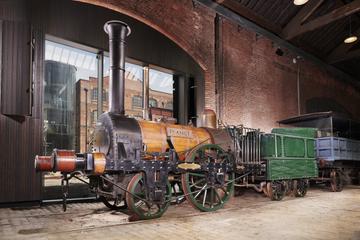
The original cylinder and parts of Braithwaite and Ericsson's "Novelty" locomotive 1829 (Now incorporated with reconstruction, Inv 1929-866).
Novelty was originally developed in 1829 by John Braithwaite and John Ericsson for the Rainhill Trials, a competition organised to find the best engine design for the new Liverpool and Manchester Railway. Novelty was fast, but it was lightly built and broke down, leaving Stephenson’s Rocket to win the Rainhill Trails.
Immediately following the Rainhill Trials, John Ericsson used Novelty in experiments and design improvements through 1829. Novelty was then briefly used on the new St Helens and Runcorn Gap Railway. Novelty was then rebuilt in 1833 by Robert Dalglish, with a new boiler, new wheels, and new cylinders. It was at this point that the original cylinder was removed and sent to John Melling who was the Locomotive Foreman of the Liverpool and Manchester Railway. He left in 1839/40 to start Rainhill Iron Works. He had previously purchased a bottling plant in Rainhill, which he used as an engineering works, this became the Rainhill Gas and Water Company.
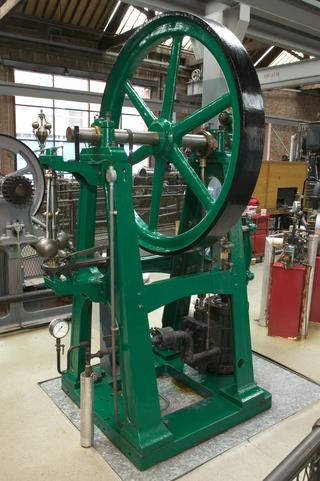
The cylinder was used to drive industrial machinery (a winch and a lathe) before being presented to the Science Museum in 1905 by the Rainhill Gas and Water Company. The surviving cylinder was incorporated into this replica of the Novelty, built by the Science Museum in 1929.
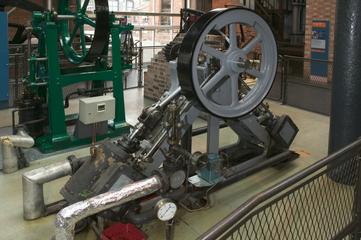
These parts are the complete cylinder with its crosshead and guide bars, the pedestal, the two side rods which connected the crosshead with the bell-crank and part of the valve gear. The cylinder is 6' diameter by 12' stroke, and stands on a small table which forms the bottom cover; the guide bars are round rods tapped into the upper cylinder flange and they also serve as cover bolts. The cylinder ports are formed in a separate brass casting screwed onto the cylinder and the valve chest is secured to this in a similar manner. The slide valve is driven by two links and a crosshead from levers on a rocking shaft below; this shaftis provided with a double-ended lever having a pin at each end, with which a gab rod, driven by a fixed eccentric on the crank axle, could engage; one pin gives the forward motion and the other the backward. The side rods and the valve rod have been altered at their lower ends to suit their subsequent uses.
Details
- Category:
- Locomotives and Rolling Stock Components
- Object Number:
- 1904-16
- type:
- locomotive cylinder
- credit:
- Donated by Rainhill Gas and Water Company