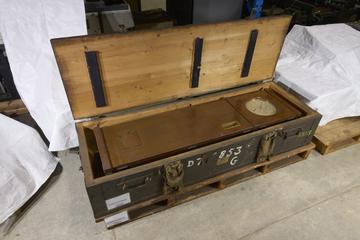
These two photographs show a Süss-Eötvös design of torsion balance from the late 19th century / early 20th century. These photographs were taken and supplied by Süss Nándor, the maker of the instrument who was based in Budapest.
Torsion balances were invented by Hungarian physist Baron Loránd Eötvös during the late 19th century. This torsion beam was built by German instrument maker and mechanic Nándor Süss who formed a professional partnership with Loránd Eötvös which last for most of their careers. Nándor Süss would also found the Magyar Optikai Müvek in 1876 (originally called the University Mechanical Station, and later the Nándor Süss Institute of Precision Mechanics) which became one of the largest companies in Europe.
It was Nándor Süss who built the torsion balances which Loránd Eötvös used to carry out a famous and highly influential physics experiment which measured the relationship between inertial mass and gravitational mass. The experiment began in 1885, but was not fully finished until 1909 and successfully proved that both forces are expressions of the same weak force, which is now understood as the 'equivalence principle'.
Albert Einstein would later use the 'equivalence principle' as laid out by Loránd Eötvös as one of the foundational ideas for what would become his theory of general relativity, which transformed modern physics.
Details
Related Objects
Section of marine cable
Wooden parts of pendulum frame
Diagram, electrical survery