Doodson-Lege tide predictor
- Made:
- 1941-1950 in United Kingdom
 This image is released under a CC BY-NC-SA 4.0
Licence
This image is released under a CC BY-NC-SA 4.0
Licence
License this image for commercial use at Science and Society Picture Library
License
Science Museum Group
© The Board of Trustees of the Science Museum
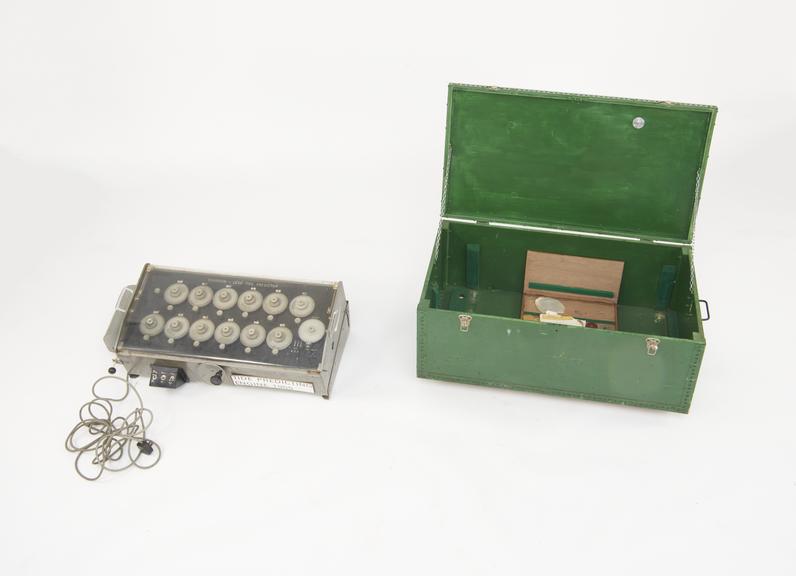
This Doodson- Légé tide predicting machine was built in the 1940s through the collaborations of Dr Arthur Doodson and the Légé and Co company based in London.
The machine is rectangular in shape and approximately 1 metre wide and 30cm tall and 30cm deep. The machine has twelve adjustable dials which control pulley wheels inside the machine, each with a corresponding Darwinian value which describes which celestial body they factor into the calculation. A single master dial on the right-hand side which shows the tidal heights being recorded. Below this master dial is the timer which controls the length of time the tide predictor will record for. Connected on the left side of the tide predictor is the power lead, alongside the power switches.
The object’s name ‘Doodson- Légé Tide Predictor’ can be seen in large text above the dials. The front of the tide predictor is covered by a sealable glass case.
Tide predicting machines are mechanical analog computers which were designed and built from the late 19th century to the mid-20th century. One of the first tide predicting machine designs was developed by George Darwin, the second son of Charles Darwin. George Darwin’s work highlighted that predicting past and future tides required measuring the tide with reference to the many dynamic astronomical factors which shaped the tides, which are called harmonic constituents. A harmonic constituent essentially represented a specific variation in the relative positions of celestial bodies such as the Earth, Moon and Sun, each of which created a distinct tide generating force. George Darwin identified over 40 distinct harmonic constituents, and his names for these constituents are still used today. For example, ‘M2’ represents the force of the Moon on the Tides.
The Doodson-Légé tide predicting machine was designed in the late 1940s by Dr. Arthur Doodson in partnership with Légé and Co based in London. This design built on the tide generating forces model developed by George Darwin, which Dr Doodson updated using more contemporary knowledge. Several different Doodson- Légé tide predicting machines have been built in the 1940s and 1950s, but all shared the same overall design which used adjustable pulley wheels, each representing a harmonic constituent being factored into the calculations of the tides. The larger Doodson- Légé machine, the more pulley wheels could be included, creating more accurate tide prediction calculations which factor in a greater number of tide generating forces.
Perhaps the most significant use of Doodson- Légé tide predicting machines was during the Second World War, when Dr Arthur Doodson and his associates used them to help choose the date for the D-Day Normandy landings, which took place on the 6th June 1943, on a day which had both a full moon and low morning tides.
This Doodson- Légé tide predicting machine is an earlier model built in the 1940s, which has 12 pulley wheels, and by extension could create tide predictions factoring in 12 different tide generating forces.
Tide predicting machines, such as this one, were in almost constant use until the early 1960s, after which they were slowly replaced by more powerful and efficient digital computers, most of which today calculating tide predictions with over 120 harmonic constituents.
Details
- Category:
- Geophysics
- Object Number:
- 1989-524
- Measurements:
-
overall: 460 mm x 1040 mm x 590 mm,
- type:
- tide predictor
- credit:
- Admiralty Hydrographic Department