Ironwork from William Strutt's (1756-1830) Cotton Mills (South Mill) at Belper, Derbyshire, 1811-12, (two columns, one beam, three tie-rods). Strutt set about finding an answer to the problem of timber-floored buildings; his mill was the most technically advanced building of its time, incorporating an iron frame and brick arches to make it 'fire proof'. Ironwork from Wm. Strutt's cotton mills 1811-1812
engineering apprentice; Derby Carriage & Wagon Works; LMS Research Department; British Rail Research Department; observer (technical assistant); Head of Security; childhood; family; school; apprenticeship; mechanical engineering degree; Derby Technical College, day release training, 1940; LMS Research Department; LMS Research Department during Second World War; Loach; Newberry; Hoskins; Warlow-Davies; Baldwin; origin of jobs; staff relations; stress concentrations; staff structure in Research Department; promotion; effect of nationalisation; working conditions; collaboration between research laboratories of other former railway companies; career progress; hobbies; degree in electrical engineering; promotion, John Littlewood; specialisation in security, from c. 1960; Chief Constable of British Transport Police; Henry Pearce; interlocking doors; Head of Security Section, c.1970; Railway Pension Fund Art Collection; asbestos, reaction to risk; tobacco freight security; tobacco freight; locks on vans; patents; fiddling on the ferry; radiator fire, Birmingham New Street; withdrawl of British Transport finance from Research Department security work; retirement, 1982; interests family; daughters; experiences, visibility tests, Collingham; viaducts; water balance on canal, Ruabon; test locomotives. d.o.b. 1919-07-04, railway work 1935-1982, London; Hastings; Lewisham; Maskery, Cyril 2000-11-15
Two cast iron windows from Wm. Strutt's cotton mills (south mill) at Belper, 1811-12. Two cast iron windows from Wm. Strutt's cotton mills (south mill) at Belper 1811-1812
Part section of 1832 Dye House ironwork from Strutt complex at Milford, with earliest bolted column/beam building connections found (1977) - 5 beams, 7 columns, 3 column ties, 1 roof tie, one main rafter (timber), section of purlin wallplate dovetail box, bolts and wedges, samples of jack arch springing special bricks and floor tiles. Part section of 1832 Dye House ironwork from Strutt complex at Milford 1832
One factory window from William Strutt's Cruciform building at Berby Mill, Milford, 1793. Factory window from the Cruciform building 1793
From the Old Mill (c.1793): Complete double ventilating slide. Complete double ventilating slide 1793
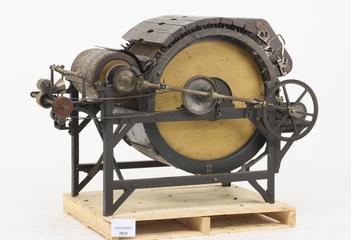
Cotton feed box, from the carding engine, by Strutts and Belper, Derbyshire, England, 1800-1830 Cotton feed box from the carding engine 1800-1830
Card Flat, from the carding engine, by Strutts and Belper, Derbyshire, England, 1800-1830 Card flat from the carding engine 1800-1830
Self-opening door from Mr. Strutt's office from the 1808 extension of William Strutt's Cruciform building at Berby Mill, Milford, 1793. Self-opening door from Mr. Strutt's office 1793
Main cylinder cover from the carding engine, by Strutts and Belper, Derbyshire, England, 1800-1830 Main cylinder cover from the carding engine 1800-1830
Hand card for cleaning the card flats, from the carding engine, by Strutts and Belper, Derbyshire, England, 1800-1830 Hand card for cleaning the card flats from the carding engine 1800-1830
Original gas-pipe, socket and spigot from William Strutt's Cruciform building at Derby Mill, Milford, 1793. Original gas-pipe, socket and spigot from the Cruciform building 1793
Section of pot roof (in two cases) from William Strutt's Cruciform building at Berby Mill, Milford, 1793. section of pot roof 1793
From the Old Mill (c.1793): Centrifugal fan for ventilating lavatories. Centrifugal fan for ventilating lavatories 1793
One large cobble stone, reinforced by iron in grooves from the yard outside William Strutt's Cruciform building at Berby Mill, Milford, 1793. one large cobble stone, reinforced by iron in grooves from outside the Cruciform building 1793
Waste collection box, from the carding engine, by Strutts and Belper, Derbyshire, England, 1800-1830 Waste collection box from the carding engine 1800-1830