Show
[Page 8]
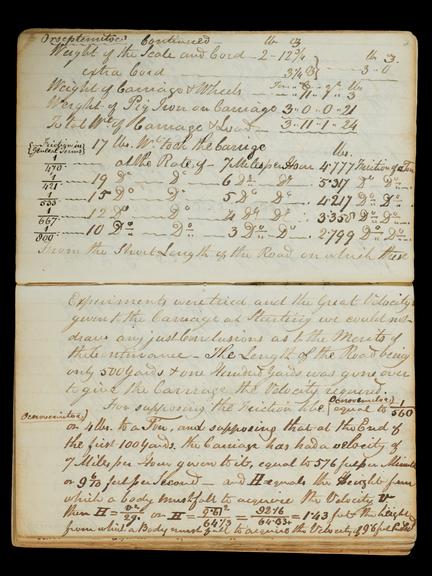
Orseptemitve Continued lb oz
Weight of the Scale and Cord 2 .. 12 ¾
extra Cord 3 ¼
3 .. 0
Tons C q2 lbs
Weight of Carriages & Wheels .. 11 .. 1 .. 3
Weight of Pig Iron on Carriage 3 .. 0 .. 0 .. 21
Total Wt. of Carriage & Load 3 .. 11 .. 1 .. 24
(Friction in General Terms)
1/470 ----- 17 lbs. Wt. took the Carriage at the Rate of – 7 miles per Hour 4.777 lbs. Friction if a Ton
1/421 ----- 19 lbs. Do Do – 6 miles per Hour 5.317 lbs. Do Do
1/533 ----- 15 lbs. Do Do – 5 miles per Hour 4.217 lbs. Do Do
1/667 ----- 12 lbs. Do Do – 4 miles per Hour 3.358 lbs. Do Do
1/800 ----- 10 lbs. Do Do – 3 miles per Hour 2.799 lbs. Do Do
From the Short Length of the Road on which these
[Page 9]
Experiments were tried and the Great Velocity given to the Carriage at Starting we could not draw any just Conclusions as to the Merits of the Contrivance – The Length of the Road being only 500 yards & one Hundred yards was gone over to give the Carriage the Velocity required.
For supposing the Friction to be Ocnovemitve equal to 1/560 or 4 lbs. to a ton, and supposing that at the End of the first 100 yards, the Carriage has had a velocity of 7 miles per hour given to it, equal to 576 feet per Minute or 9 6/10 feet per second – and H equals the Height from which a body must fall to acquire the Velocity V then H = V2/2g or H = 9.62/64 1/3 = 92.16/64.83+ = 1.43 feet the height from which a Body must fall to acquire the Velocity of 9.6 feet per Secd.