Show
[Page 10]
Ocnovemitve
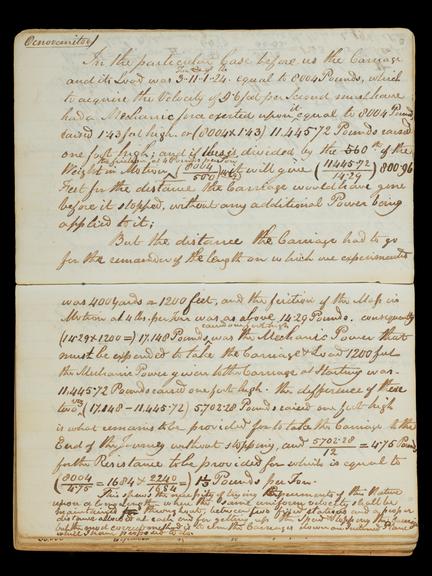
In the particular Case before us the Carriage and its Load was 3 Tons .. 11C .. 1 qr .. 24 lbs, equal to 8004 Pounds, which to acquire the Velocity of 9.6 feet per second must have had a Mechanic force exerted upon it equal to 8004 pounds raised 1.43 feet high. Or (8004 x 1.43) 11,445.72 Pounds raised one foot high; and if this is divided by the 560th of the Weight in Motion the friction at 4 pounds per ton (8004/500) 14.29 it will give (11445.72/14.29) 800.96 Feet for the distance the Carriage would have gone before it stopped, without any additional Power being applied to it.
But the distance the Carriage had to go for the remainder of the length on which one experiment
[Page 11]
was 400 yards or 1200 feet, and the friction if the Mass in Motion at 4 lbs. per ton was as above 14.29 Pounds. consequently (14.29 x 1200 =) 17,148 Pounds raised one foot high was the Mechanic Power that must be expended to take the Carriage & Load 1200 feet the Mechanic Power given to the Carriage at Starting was 11,445.72 Pounds raised one foot high. The difference of these two viz (17,148 – 11,445.72) 5,702.28 Pounds raised one foot high is what remains to be provided for to take the Carriage to the End of the Journey without stopping, and 5702.28/12 = 4.75 Pounds for the Resistance to be provided for which is equal to (8004/4.75 = 1684 x 2240/1684 =) 1 1/3 Pounds per ton.
This shows the necessity of trying Experiments of this Nature upon a long Length, where the same uniform velocity shall be maintained for throughout between two fixed stations and a proper distance allowed at each end for getting up the Speed & Stopping the Carriage but the novel current method is to run the carriages down an Inclined Plane which I have proposed to do.