Show
[Page 60]
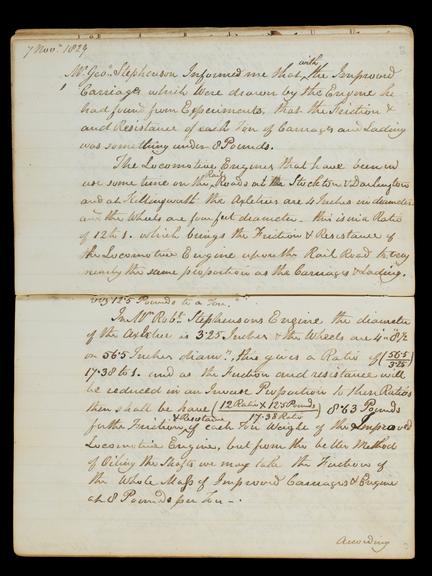
7 Novr. 1829
Mr. Geoe. Stephenson Informed me that with the Improved Carriages which were drawn by the Engine he had found from Experiments, that the Friction & and Resistance of each Ton of Carriages and Lading was something under 8 Pounds.
The Locomotive Engines that have been in use sometime on the Rail Roads at the Stockton & Darlington and at Killingworth the Axletrees are 4 Inches in diameter and the Wheels are four feet diameter – this is in a Ratio of 12 to 1. which brings the Friction & Resistance of the Locomotive Engine upon the Rail Road to very nearly the same proportion as the Carriages & Lading.
[Page 61]
viz 12.5 Pounds to a Ton.
In Mr. Robt. Stephensons Engine the diameter of the Axletrees is 3.25 Inches & the Wheels are 4’..8½” or 56.5 Inches diamr., this gives a Ratio of (56.5/3.25) 17.38 to 1 and as the Friction and resistance will be reduced in an Inverse Proportion to these Ratios then shall be have (12 Ratio x 12.6 Pounds/17.38 Ratio) 8.63 Pounds for the Friction & Resistance of each Ton weight of the Improved Locomotive Engine, but from the better Method of Oiling the Shafts we may take the Friction of the Whole Mass of Improved Carriages & Engine as 8 Pounds per Ton.
According