Show
[Page 58]
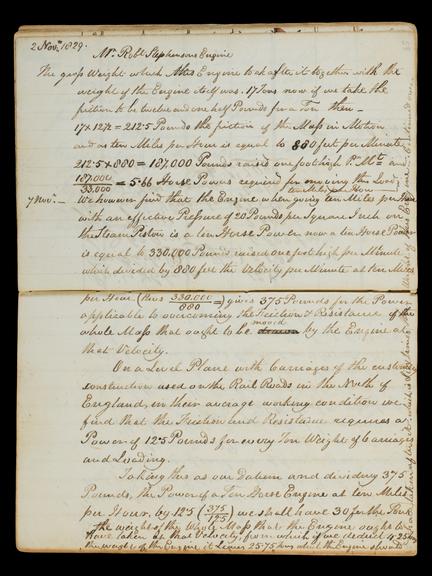
2 Novr. 1829
Mr. Robert Stephensons Engine
The gross Weight which this Engine took after it together with the weight of the Engine itself was 17 Tons now if we take the friction to be twelve and one half Pounds for a Ton then – 17 x 12½ = 212.5 Pounds the friction of the Mass in Motion and as ten Miles per Hour is equal to 880 feet per Minute 212.5 x 880 = 187,000 Pounds raised one foot high Pr. Mt. and 187,000/33,000 = 5.66 Horse Powers required for one [illegible] this Load ten miles per hour.
7 Novr.
We however find that the Engine when going ten Miles per hour with an effective Pressure of 20 Pounds per Square Inch on the Steam Piston is a ten Horse Power now a ten Horse Power is equal to 330,000 Pounds raised one foot high per Minute which divided by 880 feet the Velocity per Minute at ten Miles
[Page 59]
per hour (thus 330,000/880 =) gives 375 Pounds for the Power applicable to overcoming the Friction & Resistance of the whole Mass that ought to be drawn moved by the Engine at that Velocity.
On a Level Plane with Carriages of the customary construction used on the Rail Roads in the North of England, in their average working condition we find that the Friction and Resistance requires a Power of 12.5 Pounds for every Ton Weight of Carriages and Loading.
Taking this as our Datum and dividing 375 Pounds, the Power of a Ten Horse Engine at ten Miles per Hour, by 12.5 (375/12.5) we shall have 30 for the Tons the weight of the Whole Mass that the Engine ought to have taken at that Velocity, from which if we deduct 4.25 Tons the weight of the Engine it leaves 25.75 Tons which the Engine should have taken of after it which is Six times the Weight of this Engine _ _ Continued over