Image
Category
Object type
Material
Maker
Place
Date
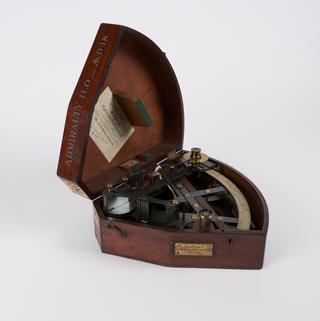
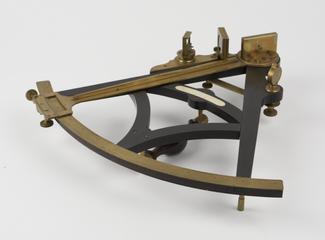
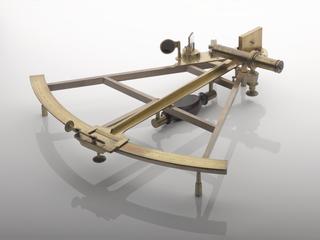
Sextant by Jesse Ramsden

Sextant by Jesse Ramsden

circa 1772

Sextant by Jesse Ramsden with case

Sextant by Jesse Ramsden with case

1770-1775

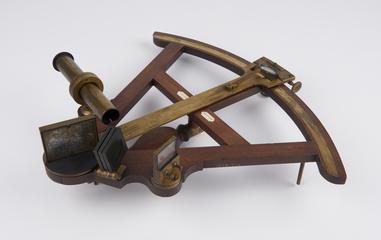
Brass Admiralty-pattern frame sextant.

Brass Admiralty-pattern frame sextant.

1925-1935

Brass framed sextant.

Brass framed sextant.

1790-1800

Brass framed sextant.

Brass framed sextant.

1757-1762

Admiralty-pattern frame sextant

Admiralty-pattern frame sextant

1942-1947

Brass double-frame sextant.

Brass double-frame sextant.

1830-1839

Brass pillar-frame sextant.

Brass pillar-frame sextant.

1826-1870

Brass triangle-pattern frame sextant.

Brass triangle-pattern frame sextant.

1880-1889

Double-frame brass sextant.

Double-frame brass sextant.

1810-1826

Brass framed sextant.

Brass framed sextant.

1835-1845

Ebony and brass sextant.

Ebony and brass sextant.

1862-1868

Ebony and brass sextant.

Ebony and brass sextant.

1785-1795

Brass pillar-frame sextant.

Brass pillar-frame sextant.

1795-1804

Mahogany and brass sextant.

Mahogany and brass sextant.

1785-1795

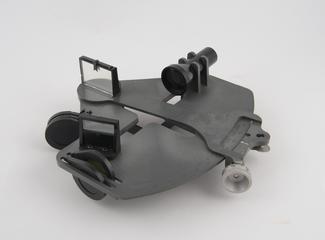
Plastic yachtman's sextant

Plastic yachtman's sextant

1970-1975

Brass triangle-pattern frame sextant.

Brass triangle-pattern frame sextant.

1940-1945

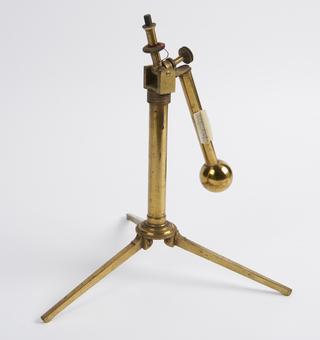
Brass pillar stand for sextant.

Brass pillar stand for sextant.

1845-1855

Brass pillar-frame sextant.

Brass pillar-frame sextant.

1810-1820

Brass framed sextant fitted with artificial horizon.

Brass framed sextant fitted with artificial horizon.

1914-1918

Diamond-frame pattern sextant with case.

Diamond-frame pattern sextant with case.

1845-1855

Brass framed sextant with case.

Brass framed sextant with case.

1775-1782

brass framed sextant.

brass framed sextant.

1943-1945

Oval pattern-frame sextant.

Oval pattern-frame sextant.

1851-1856

Brass oval-pattern frame sextant.

Brass oval-pattern frame sextant.

1850-1880

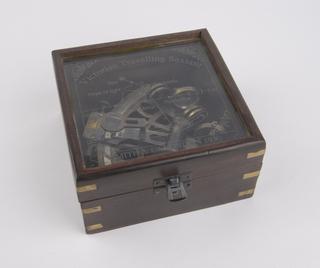
Fake nautical sextant

Fake nautical sextant

Fake travelling sextant

Fake travelling sextant

Double sextant, designed and patented by James Catt

Double sextant, designed and patented by James Catt

1909

Brass sextant with gyroscopic artificial horizon.

Brass sextant with gyroscopic artificial horizon.

1830-1870

Diamond- pattern frame quintant.

Diamond- pattern frame quintant.

1851-1882

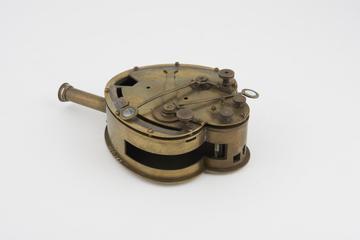
Pocket double box sextant of 2½-inch radius

Pocket double box sextant of 2½-inch radius

Brass sextant with pendulum artificial horizon.

Brass sextant with pendulum artificial horizon.

1835-1845

Box type pocket sextant

Box type pocket sextant

circa 1860

Diamond-frame pattern sextant.

Diamond-frame pattern sextant.

1845-1860

Sextant made by Edward Troughton and William Simms

Sextant made by Edward Troughton and William Simms

1840

Ebony framed sextant

Ebony framed sextant

1862-1868

Viewing telescope for Hadley type brass framed sextant

Viewing telescope for Hadley type brass framed sextant

circa 1772

Diamond- pattern frame sextant.

Diamond- pattern frame sextant.

1835-1845

Ebony  and brass sextant.

Ebony and brass sextant.

1791

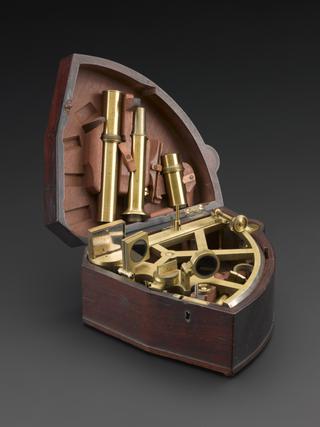
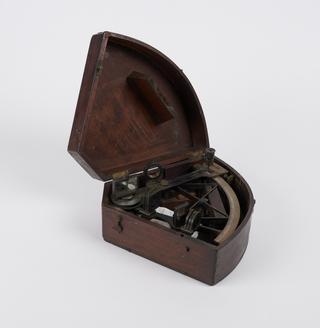
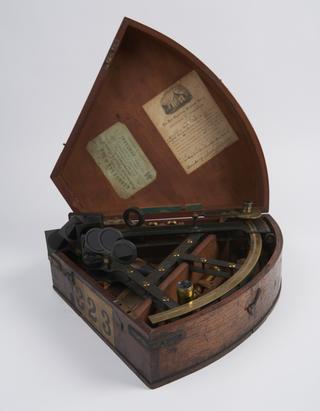
Keystone-shaped mahogany box for brass sextant with polished frame and limb, by Jesse Ramsden, London, England, 1790-1800.

Keystone-shaped mahogany for brass framed sextant.

1790-1800

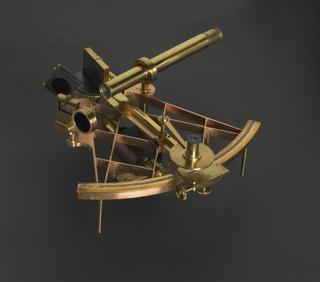
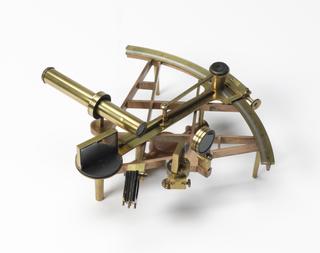
Brass sextant with polished frame and limb, by Jesse Ramsden, London, England, 1790-1800. Fitted with hinged stand instead of handle, which can be fitted to threaded hole on the lid of the case. Consists of inlaid silver 129° scale (-2° to 147°) with 20’ divisions, a silver vernier reading to 20”, three filter shades (two red, one green), three horizon shades (two red, one green) and scale magnifier on swivel arm (missing). Fitted with threaded telescope bracket (with detachable dovetail) for telescope (123 mm, set focus?) inverted image, four cross-wires and sight tube (51 mm).

Brass framed sextant.

1790-1800

Pillar sextant, 12-inch radius by J. and E. Troughton, London with brass tripod stand.

Brass framed sextant with stand.

circa 1795

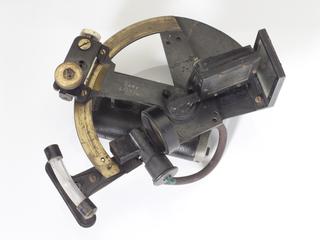
Ball recording sextant with brass and alloy frame and plastic handle in rectangular fitted wooden box with a leather strap, made by the Mergenthaler Linotype Company, Brooklyn, New York, USA, 1944. Consists of scale (0° to 90°), on reverse, with 1°’ divisions and micrometer (1’), day and night telescopes (236mm) and no filter shades. In use, the celestial body is viewed directly and instead of a plumb bob, a falling steel ball records the altitude on a screen, and is read off the scale and micrometer.

Ball recording sextant with case.

1944

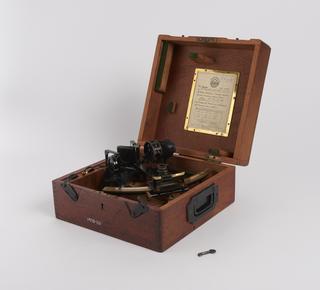
Brass lacquered sextant with straight-bar-pattern, 24 pillar frame, polished brass limb, wooden handle with counterbalanced tripod pillar stand and mercury artificial horizon in wooden box, all by John and Edward Troughton, 136 Fleet Street , London, England, 1790-1800. Consists of brass 127° scale (-5° to 140°) with 20’ divisions and brass vernier (10”), three index-filter shades (red & green), two horizon filters (red & green), scale magnifier on 90mm swivelling arm. Fitted with threaded telescope bracket for sighting telescope (182mm – inverted image) with 2 extra draw tubes, 131mm sighting tube and other accessories. The fitted rectangular case has in the lid the trade card for J. & E. Troughton. The artificial mercurial horizon consisting of a rectangular wooden trough fitted in a tin tray and a brass-framed, roof-shaped cover with glazed side panels, unsigned, made later, 1845-55.

Brass framed sextant with stand, artificial horizon and case.

1790-1800

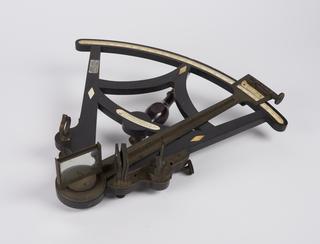
Black-lacquered sextant, diamond-pattern frame, polished brass limb and wooden handle, by H. Haecke, Berlin, Germany, 1901-1910. Consists of Consists of inlaid silver 131° scale (-2° to 152°) with 30’ divisions, silver vernier (1’ divisions) three filter shades (two grey, one green) and reading magnifier (missing). Fitted with threaded telescope bracket with telescope (89 mm, large objective) erect image; extra draw tube (53 mm) erect image and Sight-tube (53 mm). Provided with extra set of horizon filters (two grey, one green), brass cased prism and handle from another instrument.

Diamond-frame pattern sextant.

1900-1910

Brass sextant with black lacquered frame, polished brass limb, wooden handle and fitted with gyroscopic artificial horizon invented by French Admiral Fleuriais, and made by Hurlimann, Ponthus and Therrode, Paris, France, 1910-19. Consists of inlaid polished silver 126° scale (-5° to 107°) with 20’ divisions and silver vernier (30”), three index-filter shades (red, green & orange), two horizon filters (orange), scale magnifier on 70mm swivelling arm. Fitted with threaded telescope bracket for sighting telescope (191mm – upright image). Supplied with horizon light, magnifier, adjusting key and other accessories with circular brass box and mahogany case with manuscript instructions. The artificial horizon consists of an airtight housing containing a gyroscope that can be locked with a lever mechanism. The gyroscope has a glass piece through the body, with a series of horizontal lines, and is propelled by an air pump. The air gauge is calibrated from 0 to 76 cm of mercury.

Brass sextant with gyroscopic artificial horizon and case.

1910-1919

Brass sextant with lacquered frame and limb, wooden handle and fitted with artificial horizon invented by Alexander Bridport Becher in 1834, and made by William Cary, London, England, 1835-45. Consists of inlaid polished silver 126° scale (-5° to 150°) with 20’ divisions and silver vernier (20”), three index-filter shades (red & 2 green), three horizon filters (red & green), scale magnifier on 55mm swivelling arm. Fitted with threaded telescope bracket for sighting telescopes (151mm – inverted image). The horizon consists of a 93-mm-long anodized brass tube with a bracket for attaching it to the sextant. The tube contains a pendulum that is lowered into a conical attachment (missing) filled with almond oil to dampen the pendulum's movement. A separate oil lamp (missing) can be fixed to the bracket for illumination at night.

Brass sextant with pendulum artificial horizon.

1835-1845

Sextant with polished brass and gunmetal frame, polished brass limb, detachable wooden handle and fitted mahogany case, by Matthew Berge, London, England, 1810-1815. Consists of inlaid polished silver 131° scale (-2° to 155°) with 20’ divisions and vernier, four index-filter shades (red & green) and three horizon filters (red & green), scale magnifier on 80mm swivelling arm. Fitted with threaded telescope bracket for sighting telescopes (62mm – erect image 134mm – inverted image & 58mm – tube) and detachable silvered plate for reading scales.

Brass framed sextant.

1810-1815

Brass sextant with straight-bar-pattern pillar frame, wooden handle threaded for use on stand in fitted keystone mahogany case, by Edward Troughton and William Simms, London,1824-51. Consists of polished inlaid silver scale with silver vernier (10”), four index-filter shades, three horizon filters and magnifier on a swivelling arm. Fitted with threaded bracket for sighting telescope (75mm – erect image & 87mm – inverted image), plus extra draw tube and sighting tube (131mm). Other accessories include leather-capped adjusting key and magnifying glass. On the lid of the storage case is a certificate of examination of the National Physical Laboratory, dated May 1907, a printed instruction on how to store the instrument in the box, and a MS note dated 1902 on the index error.

Brass pillar-frame sextant with case.

1824-1851

Marine sextant, 6-inch radius limb, with two viewing telescopes, two shaded eyepieces in wooden case by Henry Hughes and Son Ltd, London, England ,1903-1947.

brass framed sextant.

1903-1947